On The Shelf: What We’re Reading: Fruitful Legacy: A Historic Context of Orchards in the United States

Fruitful Legacy: A Historic Context of Orchards in the United States, with Technical Information for Registering Orchards in the National Register of Historic Places

Author: Susan A. Dolan

url

Order: from The US Government Bookstore here

GPO Stock Number: 024-005-01266-4     ISBN:9780160821271
USA Price: $39.00   International Price: $54.60
Publisher: Interior Dept., National Park Service, Olmsted Center for Landscape Preservation, Pacific West Regional Office, Cultural Resources;
Park Historic Structures and Cultural Landscapes Program
Author: Dolan, Susan A.
Year/Pages: 2009: 251 p.; col. ill.   Binding: Paperback  Cover: Paper

Read and download: Online here at archive.org
See: National Parks Service: Cultural Landscapes

Nomeclature and Regional Expression: Pomme de Fer & Red Winter Pearmain

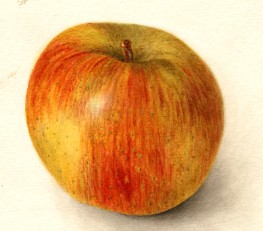
POM00002970PommedeFerCaliforniaImages of (4) different apple specimens from the NAL Library USDA Pomological Watercolor Collection

4 specimens

Collected from 3 locales in 3 States:

California, Vermont, Maine

From 3 different North American growing regions

Nomenclature: Pomme de Fer and Red Winter Pearmain

“An interesting little apple, to which I may draw your attention later in the report on new fruits, is this 
Pomme de Fer, literally the Iron apple, which originated in the Province of Quebec. It is a small dark apple and keeps easily until June.” 1
 
“Nevertheless Quebec has enriched American pomology by the gift of an apple which has added abundantly to the wealth and comfort of the people of North Eastern America.  To know this apple is to appreciate its great beauty and its surpassing fine quality.  But one should have it grown in the islands of Lake Champlain or in Western Quebec to secure it in all its glowing beauty and in all its crisp lusciousness.  You have no doubt guessed ere this that there is only one apple meriting this description La Belle Fameuse.  Quebec Tradition – because precise history fails – tells us that the Fameuse came to us with the advent of the Norman colonists.  It is the characteristic apple of the upper St Lawrence valley and I might add of the Lake Champlain region.  Fruit growing in the Province began as no doubt it did in New England with the growing of seedling fruits in the gardens of those who had brought with them from the old land a love of horticulture. The early gardens of Quebec and Montreal were famous for their collections of apples and even of pears. From these early plantings many varieties of some local fame have originated.  In addition to the Fameuse and its large seedling progeny might be mentioned St Lawrence, Pomme de fer, and Canada Baldwin.” 2


Malus domestica: Pomme de Fer, 1913. Isle La Motte, Grand Isle County, Vermont, United States.

POM00000680pommedeFer 1913

Malus domestica: Pomme de Fer

Artist:
Newton, Amanda Almira, ca. 1860-1943
Scientific name:
Malus domestica
Common name:
apples
Variety:
Pomme de Fer
Geographic origin:
Isle La Motte, Grand Isle County, Vermont, United States
Physical description:
1 art original : col. ; 16 x 25 cm.
Specimen:
66348
Year:
1913
Date created:
1913-10-29
Rights:
Use of the images in the U.S. Department of Agriculture Pomological Watercolor Collection is not restricted, but a statement of attribution is required. Please use the following attribution statement: “U.S. Department of Agriculture Pomological Watercolor Collection. Rare and Special Collections, National Agricultural Library, Beltsville, MD 20705”

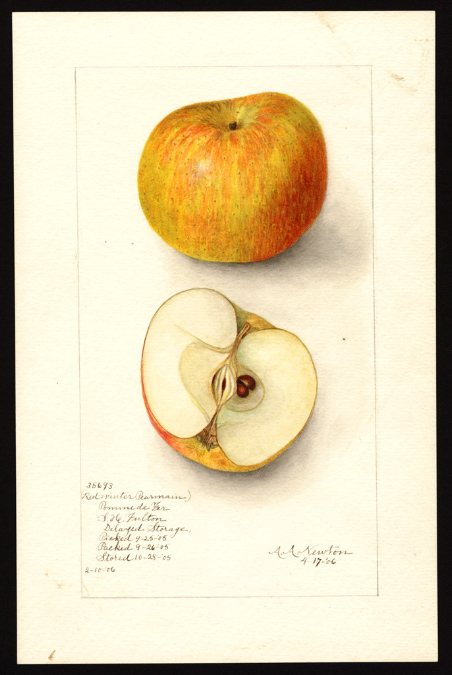
Malus domestica: Red Winter Pearmain (Alternative variety name(s): Pomme des Fer) 1906. Watsonville, Santa Cruz County, California, United States.

POM00002969.RedWinterPearmianCA(PommedesFer)jpg

Malus domestica: Red Winter Pearmain

Artist:
Newton, Amanda Almira, ca. 1860-1943
Scientific name:
Malus domestica
Common name:
apples
Variety:
Red Winter Pearmain
Geographic origin:
Watsonville, Santa Cruz County, California, United States
Physical description:
1 art original : col. ; 17 x 25 cm.
NAL note:
Alternative variety name(s): Pomme des Fer
Specimen:
35693
Year:
1906
Notes on original:
Delayed Storage (35694). Picked 09/25/1905. Packed 09/26/1905. Stored 10/28/1905
Date created:
1906-04-17
Rights:
Use of the images in the U.S. Department of Agriculture Pomological Watercolor Collection is not restricted, but a statement of attribution is required. Please use the following attribution statement: “U.S. Department of Agriculture Pomological Watercolor Collection. Rare and Special Collections, National Agricultural Library, Beltsville, MD 20705”

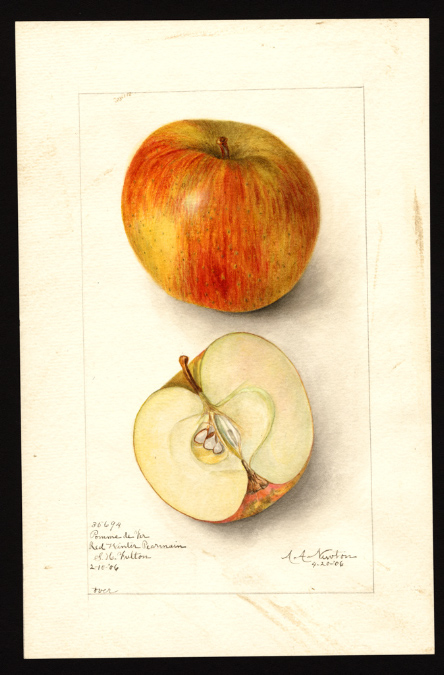
Malus domestica: Pomme de Fer, 1906. Watsonville, Santa Cruz County, California, United States.

POM00002970Pomme de Fer 1906

Malus domestica: Pomme de Fer

Artist:
Newton, Amanda Almira, ca. 1860-1943
Scientific name:
Malus domestica
Common name:
apples
Variety:
Pomme de Fer
Geographic origin:
Watsonville, Santa Cruz County, California, United States
Physical description:
1 art original : col. ; 17 x 25 cm.
NAL note:
Alternative variety name(s): Red Winter Pearmain
Specimen:
35694
Year:
1906
Notes on original:
Immediate Storage; Picked 9/25/1905; Shipped 09/28, Stored 10/16/1905. See 35693; Packed 9/26/1905
Date created:
1906-04-20
Rights:
Use of the images in the U.S. Department of Agriculture Pomological Watercolor Collection is not restricted, but a statement of attribution is required. Please use the following attribution statement: “U.S. Department of Agriculture Pomological Watercolor Collection. Rare and Special Collections, National Agricultural Library, Beltsville, MD 20705”

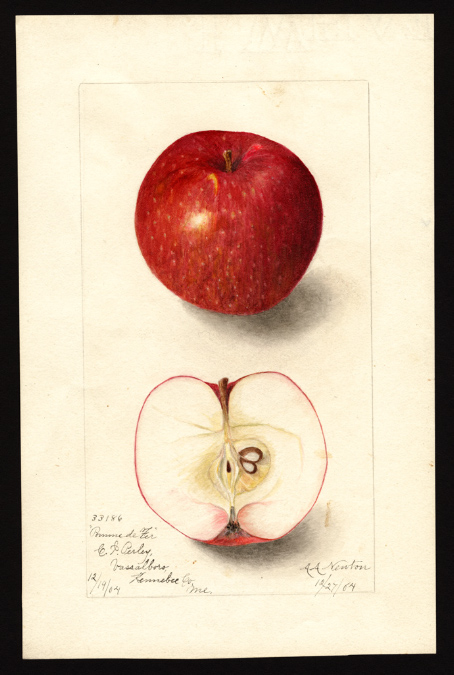
Malus domestica: Pomme de Fer, 1904. Vassalboro, Kennebec County, Maine, United States.

POM00000679Pomme de Fer 1904Malus domestica: Pomme de Fer

Artist:
Newton, Amanda Almira, ca. 1860-1943
Scientific name:
Malus domestica
Common name:
apples
Variety:
Pomme de Fer
Geographic origin:
Vassalboro, Kennebec County, Maine, United States
Physical description:
1 art original : col. ; 17 x 25 cm.
Specimen:
33186
Year:
1904
Date created:
1904-12-27
Rights:
Use of the images in the U.S. Department of Agriculture Pomological Watercolor Collection is not restricted, but a statement of attribution is required. Please use the following attribution statement: “U.S. Department of Agriculture Pomological Watercolor Collection. Rare and Special Collections, National Agricultural Library, Beltsville, MD 20705”

The Pomological Magazine, Volume No. 1. John LIndley, London 1828

n33_w1150n201_w1150n197_w1150n193_w1150n189_w1150n185_w1150
n181_w1150n177_w1150n173_w1150n169_w1150n165_w1150n161_w1150
n157_w1150n153_w1150n149_w1150n145_w1150n141_w1150n137_w1150
n133_w1150n129_w1150n124_w1150n121_w1150n117_w1150n113_w1150

The Pomological Magazine: or Figures and descriptions of the most important varieties of fruit cultivated in Great Britain.
Volume No. 1
Editor: John Lindley.

Illustrator: Augusta Innes Baker Withers

Engraving by S. Watts

Published by John Ridgeway, London, 1830.

48 copperplate engravings. A set on Flicker.

Via Flickr:
The Pomological magazine v.1
London;J. Ridgway.
biodiversitylibrary.org/item/71181

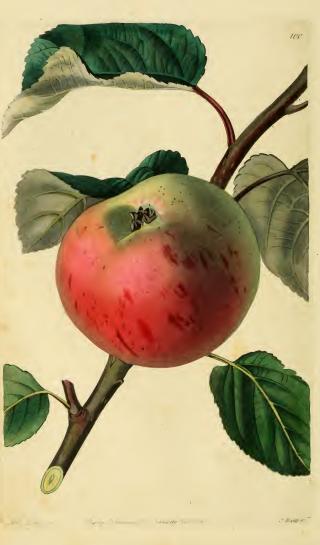
Pomological Illustration: Irish Peach Apple by John Lindley

IrishPeach-Lindley

Irish Peach Apple, a copperplate engraving by John Lindley from The Pomological magazine; or, Figures and descriptions of the most important varieties of fruit cultivated in Great Britain

Irish Seed Savers: List of Best 10 Irish Apples

Irish Seed Savers

Best 10 Irish Apples by Kevin Dudley, at the ISSA website includes: No. 1

1. IRISH PEACH (EARLY CROFTON)
Late July/Early August
The best of the summer apples to ripen and one of the best flavoured of the Irish varieties. One of four Irish desert apples from the Crofton Estate in Sligo, possibly dating back to the reign of Elizabeth 1 (late 1500s or early 1600s) This smallish green/yellow flushed with carmine striped crisp fruit was much planted in the UK in the 1900s and is a pure tip-bearer of moderate vigour with a spreading habit. The fruit is best eaten straight from the tree (or within two days of picking) when it has a crisp juicy texture and an aromatic/rich vinous flavour. This variety has little commercial potential as it quickly becomes soft and dry. The main problem is scab, which can affect the fruit badly with leaves and buds also getting scab to a lesser extent.

Other apples listed in the Best 10 Irish Apples:

WIDOWS FRIEND

KERRY PIPPIN

EIGHT SQUARE or KILL APPLE

CAVAN SUGARCANE

ARD CAIRN RUSSET

ROSS NON PAREIL

KILKENNY PEARMAIN

KEEGANS CRAB

SAM YOUNG

Read the article Best 10 Irish Apples to find out more details about Irish apples.

Sam Young Apple

Sam Young apple. Illustration, copperplate engraving from “The Pomological Magazine’, editor John Lindley, published in London, by James Ridgeway in 1830.

Malus domestica: Irish Peach in situ Durley, Hampshire, UK

Video from Stephen Hayes, Durley, Hampshire, UK

blog: Fruitwise Heritage Apples