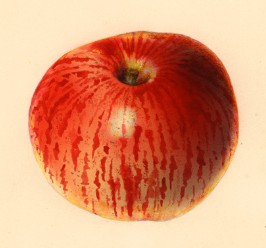
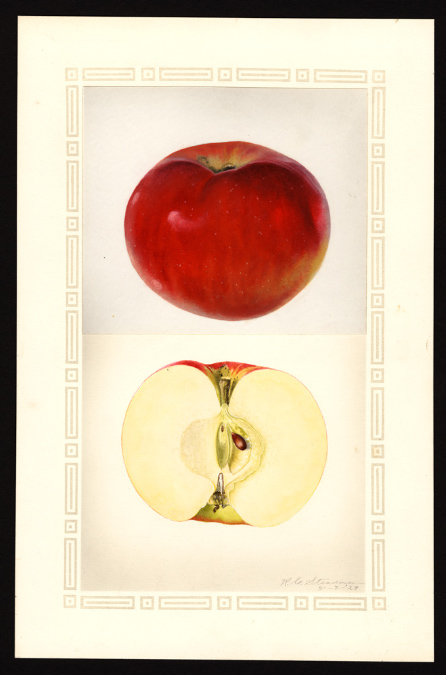
Malus domestica: Red Gravenstein, 1929. Rosslyn, Arlington County, Virginia, United States

POM00003063

Malus domestica: Red Gravenstein

Artist:
Steadman, Royal Charles, b. 1875
Scientific name:
Malus domestica
Common name:
apples
Variety:
Red Gravenstein
Geographic origin:
Rosslyn, Arlington County, Virginia, United States
Physical description:
1 art original : col. ; 17 x 25 cm.
Specimen:
111014
Year:
1929
Notes on original:
Section J, Row 25, Tree 3; Picked 07/23/1929
Date created:
1929-08-07
Rights:
Use of the images in the U.S. Department of Agriculture Pomological Watercolor Collection is not restricted, but a statement of attribution is required. Please use the following attribution statement: “U.S. Department of Agriculture Pomological Watercolor Collection. Rare and Special Collections, National Agricultural Library, Beltsville, MD 20705”

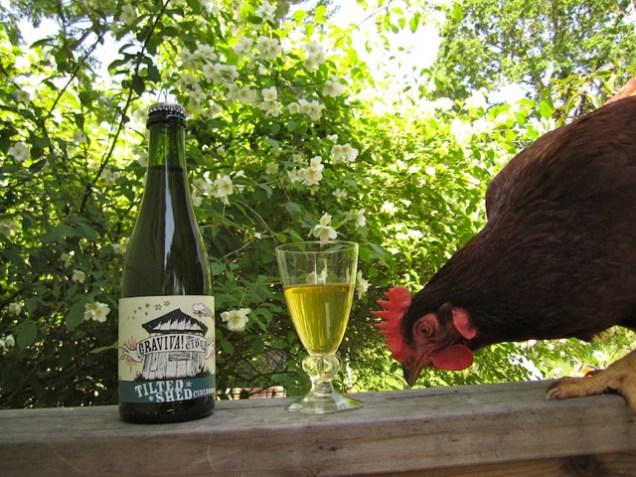
5Ws of Cider: Scott Heath and Ellen Cavalli. Tilted Shed Ciderworks 2012 Graviva! Semidry Cider

5Ws of Cider: Scott Heath and Ellen Cavalli & Tilted Shed Ciderworks 2012 Graviva! Cider.

grav big red
Ellen Cavalli of Tilted Shed Ciderworks in Sonoma County, California answers our 5Ws of Cider pairing questions:

WHO: Scott Heath, co-owner & cidermaker, and Ellen Cavalli, co-owner & sales and marketing director.

WHAT:  Tilted Shed Ciderworks 2012 Graviva! Semidry Cider

Graviva! is our homage to the beleaguered, beautiful Gravenstein, which was Sonoma County’s main agricultural crop until post-WWII, when imported apples and eventually the wine industry put the squeeze on growers. Now there are around 600 acres left in cultivation, down from a few thousand just a couple of decades ago. It’s a blend of 50% Gravs with 50% heirloom and cider apples, including Hubbardston Nonesuch (a low-tannin, low-acid sweet from 1830s Massachusetts) and Nehou (a high-tannin, low-acid bittersweet from 1920s France), all organically grown on Sonoma County farms. It’s a lightly effervescent, bright, crisp cider with refreshing acidity, slight floral aroma, and a touch of sweetness and tannin.

We hand-washed, sorted, ground, and pressed the apples from August to October 2012 at our small cidery in west Sonoma County. Then Scott sent the juice onto a cool, slow fermentation in small batches until late March 2012. Our process is more akin to white wine production; the long fermentation allows the cider to develop more nuance and aromatics, which may be lost in a fast, hot ferment. Then Scott blended it, aged it for a month, then began bottling by hand. We released Graviva! in early May, for a total of 400 gallons.

WHAT TO PAIR WITH : Graviva! is fantastic as an aperitif, with cheeses (especially the sheep and cow dairy cheeses by our friends at Weirauch Farm & Creamery) and charcuterie. Its balance of acidity, sweetness, and tannin also makes it a great accompaniment to pork tenderloin, salmon, oysters, and spicy foods (especially curry dishes). I most like to pair it with is a hammock on a sunny day, but our most memorable pairing was with local salmon.
x
We serve it lightly chilled; 50 to 55 degrees is the sweet spot for releasing the aromatics.
x
WHEN & WHERE: The most memorable pairing we had with Graviva! was in late July 2012 at our house. Scott had just turned the Big 40, and we were three weeks away from launching our very first batches of ciders at Sebastopol’s Gravenstein Apple Fair. Early in the morning, Scott drove out to nearby Bodega Bay, where he bought a whole salmon straight off the fisherman’s boat. He smoked it in our wood smoker, and also made focaccia from scratch. Meanwhile, I picked and prepared a bunch of vegetables from our garden: cucumbers, carrots, green beans, and Sungold tomatoes. Our good friends and their kids came over, one friend brought the yummiest carrot cupcakes, we busted out a few as-yet-unlabeled bottles of Graviva! (we were still waiting to get the labels from the printer!), feasted on the best salmon we’ve ever had, and had a fun, noisy dinner party on our deck.

WHY: There is something inherently celebratory about Graviva! Not only did it make for a convivial dinner, it’s been poured instead of Champagne at weddings, and we recently served it on Mother’s Day as a toast to my  mom.

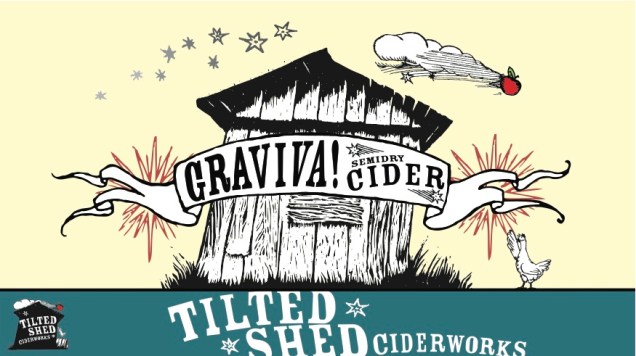
Graviva! label5-13X

To find out more:
Note: The lovely chicken pictured is a Rhode Island Red, and her name is Big Red.


5Ws of Cider: Tilted Shed Ciderworks 2012 Graviva! Semidry Cider

Graviva! label5-13X

The Second installment of The 5Ws of Cider:

The Featured Cider:

Tilted Shed Ciderworks 2012 Graviva! Semidry Cider

The Gravenstein sparkles in this bright, crisp cider. The refreshing acidity is balanced with a touch of sweetness. We sourced the Gravs and other heirloom cider apples for this blend from organic growers in the Sebastopol area. The Grav lends its lovely aromatics, while a mix of “bittersweet” apples—which were specially developed over the centuries for fermented cider—imparts lively tannins. This is Sonoma County heritage in a bottle. Viva la Grav!Great as an aperitif or celebratory bubbly, or pair with aged cheeses, spicy foods, and a hammock. Silver medal winner at the 2013 Great Lakes International Cider and Perry Competition.

2012 harvest

7% ABV

375 & 750 ml

Picture

International Day for Biological Diversity: We Celebrate Heritage Apples: The Gravenstein

22 May is International Day for Biological Diversity.

This Year’s Theme Is:  Water & Biological Diversity.

We Celebrate Heritage Apples.

And continue our Pomme Fruit of the Month focus on The Gravenstein.

Resources:

Slow Food USA: Ark of Taste: Sebastopol Gravenstein Apple

Slow Food USA: Sebastopol Gravenstein Apple Presidium

Slow Food Canada: Ark of Taste: Nova Scotia Gravenstein Apple

(Pomme Gravenstein de la Nouvelle Écosse)

Gravenstein

The juice of the apple is naturally affected by the condition of the fruit itself. Sound words from the Encyclopedia Britannica 1911

cropped-observations.jpg

Fruit-growers who look to cider-making “as a means of utilizing windfalls and small and inferior apples of cooking and dessert varieties not worth sending to market” should be warned that it is as important to the cider industry that good cider only should be on sale as it is to the fruit-growing industry that good fruit only should be sent to market. The juice of the apple is naturally affected by the condition of the fruit itself, and if this be unripe, unsound or worm-eaten the cider made from it will be inferior to that made from full-grown, ripe and sound fruit. If such fruit be not good enough to send to market, neither will the cider made from it be good enough to place before the public. Nevertheless, it may furnish a sufficiently palatable drink for home consumption, and may therefore be so utilized. But when, as happens from time to time in fruit-growing districts, there is a glut, and even the best table fruit is not saleable at a profit, then, indeed, cider-making is a means of storing in a liquid form what would otherwise be left to rot on the ground; whilst if a proportion of vintage fruit were mixed therewith, a drink would be produced which would not discredit the cider trade, and would bring a fair return to the maker. (C. W. R. C.)

source: http://www.1911encyclopedia.org/Cider

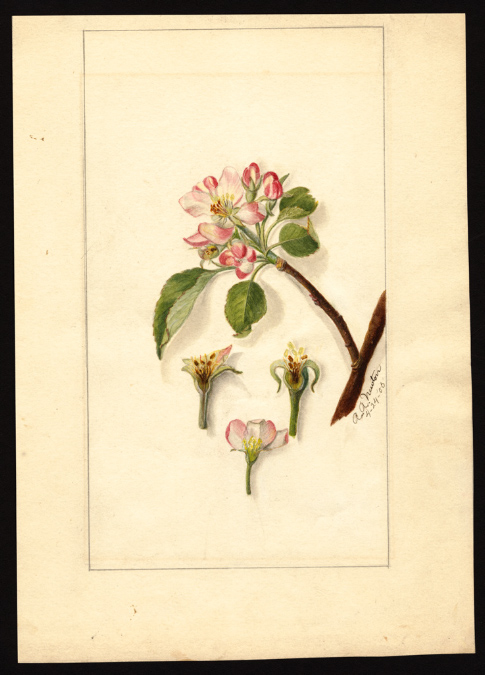
Malus domestica: Apple Blossom: Subject Apple Frost Injury

POM00001279

Malus domestica

Artist:
Newton, Amanda Almira, ca. 1860-1943
Scientific name:
Malus domestica
Common name:
apples
Geographic origin:
Woodwardville, Anne Arundel County, Maryland, United States
Physical description:
1 art original : col. ; 17 x 24 cm.
NAL note:
Painting is of an apple blossom; Assigned specimen number
Specimen:
[00010]
Year:
1905
Notes on original:
Subject Apple Frost Injury. Apple blossoms from Woodwardville, Maryland. This shows the characteristic injury by frost which occurs when the apples are in bloom or in bud. The pistils and ovules being partly killed and the floral envelopes wholly uninjured. The stamens are mostly uninjured, some of the inner ones having gone down with the ovary. The youngest blossoms in bud at the time were not injured. The most advanced flowers were hurt the most.
Date created:
1905-04-24
Rights:
Use of the images in the U.S. Department of Agriculture Pomological Watercolor Collection is not restricted, but a statement of attribution is required. Please use the following attribution statement: “U.S. Department of Agriculture Pomological Watercolor Collection. Rare and Special Collections, National Agricultural Library, Beltsville, MD 20705”

Cider Review: Breezy Hill Orchard Barrel Tasting. Cider Salon: Six Samples and Ciders. Cider 52

Trained&PrunedAppleTree

Cider: (6) Various ciders and barrel samples.

Maker: Breezy Hill Orchard and Cider Mill

Origin: Staatsburg, New York

website: www.hudsonvalleycider.com

Fruit: Apple. Various orchards.

Cider Maker: Elizabeth Ryan


Cider: Hudson Valley Farmhouse Stone Ridge Scrumpy

Maker’s Style Notes: It’s alive! Fresh apple flavors and the aromas of yeast, some residual sugar, and natural carbonation in the bottle bring you a drink for all seasons. No sulfur, very unfiltered.

Our Impressions: A full round mouthfeel, yeast and honey aromas, apple syrup sweetness, effervescent.


Cider: Hudson Valley Farmhouse Farmhouse Cider

Maker’s Style Notes: American apple varieties grown in the Hudson Valley and a bit of sweetness make a refreshing beverage that can be sipped by itself or with a meal. No sulfur, not filtered.

Our Impressions: A favorite old friend that we always enjoy visiting. Zesty and alive, a refreshing anytime cider. Provokes rustic 18th century thoughts.

Cider: Hudson Valley Farmhouse Apple Seed Cider

Maker’s Style Notes: A blend of American and European cider apples creates rich, more complex aromas. Strong acidly like crisp white wine means you can pair this cider with any meal. Barrel samples, unfiltered.

Our Impressions:  Winey. Reminiscent of Sauvignon Blanc. Crisp and silky.

Cider: Hudson Valley Farmhouse Lady Apple Cider

Maker’s Style Notes: A single varietal. Unfiltered. Made by the ancient Pomme d’api. Brought by the Romans to England.

Our Impressions: Easy drinking. Mellow apple flavor. More sweet than tart but balanced. A fine lady indeed.

Cider: Dabinett Blend -Barrel Samples

Maker’s Style Notes: A beloved French variety. Complex flavors and more tannins. Unfiltered.

Our Impressions:  Pleasing subtle structure with soft tannins and a smooth light sweetness.

Cider: Ellis Bitter Blend – Barrel Samples

Maker’s Style Notes: A unique blend of bitter and acidic apples. Unfiltered.

Our Impressions: Complex and intense. A diverse array of bitter flavor elements are present more so than we have ever experienced as most commercially available ciders tend to have one or two bitter notes if any at all. Symphonic with lots of tannins and acid that support and supply structure. Delectably illustrates the concept of blending for structure and balance and unique fruit expression. Makes us curious to find out more about the old English cider apple, Ellis Bitter, used in this blend.

Note: All of these ciders and barrel samples were tasted May 10, 2013 at the Cider Salon hosted by Jimmy’s No. 43 to benefit Breezy Hill Orchard and Cider Mill and their campaign to raise funds to Rebuild Historic Cider House at Greenmarket Farm Breezy Hill. Find more about funding and rewards via Kickstarter.

Cider Knowledge: This type of tasting is a terrific way to get a glimpse into the growers and cidermakers process and learn a bit about how they approach fruit choices and utilize blending in the development of their fruit and cider portfolio.

Note on fruit sources: Elizabeth Ryan is the primary grower and principle cidermaker. Multiple orchards supply the fruit for these ciders.
 

IAMCIDER. Photographer Bill Bradshaw.

Screen Shot 2013-04-17 at 19.41.08
IAMCIDER. Photographer Bill Bradshaw.
x
If you know the world of cider, you are likely familiar with the work of UK-based photographer and author, IAMCIDER. Bill Bradshaw.
x
A professional photographer who began documenting cider culture in words and pictures as part of a 2004 project recording children’s experiences in orchards for local heritage initiative, Apple Villages, IAMCIDER explores “the fringes of the cider world through a lens”.
x
Visit his site to read more about the roots of IAMCIDER, and view his extensive collection of cider images.
x
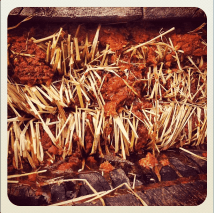
When not capturing the world with his professional kit – he sometimes shoots with his phone. The deceptively easy and accessible qualities of ‘phoneography’, belie the craft of the shooter, while the simplicity and immediacy of the process enhance the ‘real-ness’ of these images, intimately engaging the viewer.
X
To find out more about IAMCIDER. Bill Bradshaw, and the many cider and apple projects he has in the works, including 3 upcoming cider books, visit these links:
IAMCIDER. Bill Bradshaw
Twitter:  @IAMCIDER
Skype:  the.bill.bradshaw
All images courtesy of the photographer. All images copyright © Bill Bradshaw

Terminology: Defining The Fruit

061_medium

Defining the Fruit 

From The National Association Of Cider Makers “The voice of the UK’s cider makers”.

website: cideruk.com 

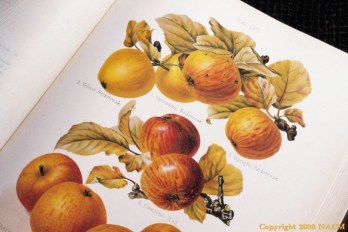
Cider apple varieties are divided into four categories according to the relative proportion of acidity and tannin:

Sweet varieties are the blandest of the four categories, being low in both components. They are useful to blend with ciders from the more strongly flavoured varieties, which, by themselves, would be too extreme in taste and aroma to be palatable. Typical examples of sweet apples are Sweet Coppin, in use to a small extent, and Court Royal which was used extensively at one time but rarely used nowadays.

Bittersweet apples impart the characteristic flavour of English ciders; as the name implies they are low in acid and high in tannin. The latter is responsible for two sensations on the palate – astringency and bitterness. In the bittersweet apple, there is a whole range of combinations of these two characteristics, varying from little astringency coupled with intense bitterness to very marked astringency coupled with mild bitterness. Typical bittersweets are Dabinett, Yarlington Mill and Tremlett’s Bitter.

Sharp varieties, so called because the predominant characteristic is that of acidity, are encountered less frequently today, possibly because culinary fruit, which has a similar flavour balance, can be substituted for this class. There are, however, recognised full sharp cider varieties, two of which are Crimson King and Brown’s Apple.

Bittersharp is the fourth class of cider apple. These are fairly high in acid and tannin, although the latter component does not show the wide range of flavours exhibited by the bittersweet.  Stoke Red is a good example.

Image: 1860s Cider Apples from The Herefordshire Pomona. Illustrations by Miss Ellis and Miss Bull.

Image and definitions courtesy of NACM. Used by permission.

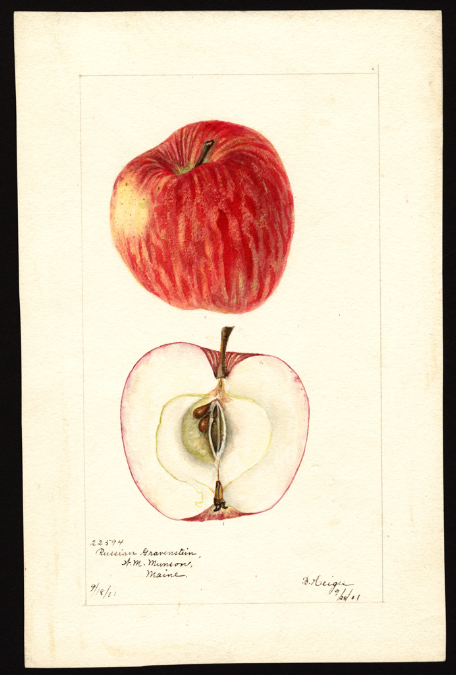
Malus domestica: Russian Gravenstein, 1901. Maine.

Russian Gravenstein

Malus domestica: Russian Gravenstein

Artist:
Heiges, Bertha
Scientific name:
Malus domestica
Common name:
apples
Variety:
Russian Gravenstein
Geographic origin:
Maine, United States
Physical description:
1 art original : col. ; 17 x 25 cm.
Specimen:
22594
Year:
1901
Date created:
1901-09-28
Rights:
Use of the images in the U.S. Department of Agriculture Pomological Watercolor Collection is not restricted, but a statement of attribution is required. Please use the following attribution statement: “U.S. Department of Agriculture Pomological Watercolor Collection. Rare and Special Collections, National Agricultural Library, Beltsville, MD 20705”