Tasting Lab: Recipe: Fromage Fort with Farnum Hill Extra Dry Cider

Fromage Fort, French “strong cheese” is usually made with bits of leftover cheese, the more variety the better, and moistened with dry white wine, chicken stock, or leek broth.

Tasting Lab: Our version of Fromage Fort is made with cider instead of dry white wine.

We selected Farnum Hill Extra Dry Cider*, collected the assorted cheese scraps we had on hand, chopped them into a fairly fine mince, smashed 3 small garlic cloves, filled our jar with the garlic and cheese, splashed in about 2/3 cup of Farnum Hill Extra Dry Cider, leaving more than enough cider enough to enjoy a glass or two. We skipped the salt and pepper as our blend contained many already flavorful cheeses, and figured we could add seasoning later if needed.

There are more detailed recipes, but this is not one of them.

Our Strong Cheese with Cider is “maturing” the refrigerator. You can eat this right away as a mild spread on toasted bread or crackers, and a few moments in the oven or under the broiler to melt and brown the cheese is often recommended. Contemporary recipes suggest a whirl in the food processor, but we went traditional and chopped with a knife – giving us a better sense of the types of rind bits we were incorporating.

Note: Remove cloth or wax rinds – we left all other rinds intact, because we like cider and we also like cheese, and rinds are very important part of the cheese flavor experience. You of course, are welcome to trim your rinds, if that is to your taste. (If your cheese has odd bits of uncharacteristic mold – you should trim those off).

Traditionally you age the Fromage Fort, and most modern recipes suggest the mixture can mature for a week or two (if it lasts that long).

For an interesting read see  Turning Leftover Cheese Into a Classic from The 1989 New York Times series, The Purposeful Cook, by Jacques Pepin. If you are interested in foodways, Jacques Pepin’s style of storytelling, sharing personal food history, and teaching culinary methods while explaining a recipe, is enlightening.

Purposeful indeed – with a happy frugality, appreciating that abundance is not to be squandered, scraps are to be saved, transformed and savored.

And for a complete different take on ‘Strong Cheese’ read Fromage Fort: The Cheese That Tried To Kill Me by Francis Lam at Salon.

* we topped our mix off with a bit of Farnum Hill Semi-Dry Cider.
Cider Mixology: Brewer & Keep Cocktail with Millstone Ciderberry

shakersmonotone

Woodberry Kitchen in Baltimore, Maryland received two semi-finalist nominations from the James Beard Foundation this year for Outstanding Bar Program and Best Chef: Mid-Atlantic region.

Connor Rasmussen, mixologist at Woodberry Kitchen shares his recipe for the Brewer & Keep: “It’s a wonderfully balanced cocktail, and the cider is a crucial aspect (despite being the final ingredient)”.

Brewer & Keep –
.75oz raw honey gin (Barr Hill)
.75oz smokey whiskey (High West Campfire)
.75oz wort (a grain tea that is a part of the brewing process)
.25oz maple syrup
.25oz lemon juice

Shaken | double strained into a 4oz coupe glass | topped with the Millstone Ciderberry.

Millstone Ciderberry is crafted from local raspberries pressed straight from the farm and blended with Millstone oak aged cider.

Visit Millstone Cellars site to learn more about the Monkton, Maryland craft cidermaker: www.millstonecellars.com

For a bit more about Millstone’s cidermakers, read this April 10, 2013 article by Richard Gorelick in The Baltimore Sun.

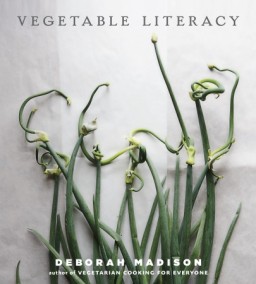
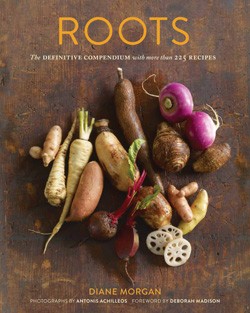
Earth Day Reading: Vegetable Literacy & Roots. Pair with American Craft Cider.

www.randomhouse

Deborah Madison Vegetable Literacy

Roots Diane Morgan

9780811878371_norm

Cider Review: 1626 New Amsterdam Dinner at The Farm on Adderley: Cider In Context

New Amsterdam Dinner at The Farm on Adderley: Cider In Context

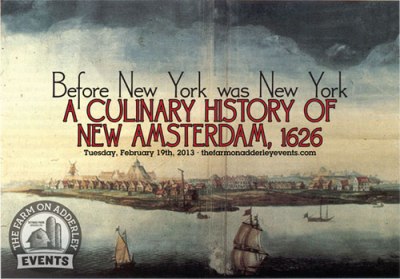
Before New York Was New York: A Culinary History of New Amsterdam, 1626

New-Am-Flier

Venue: The Farm on Adderley restaurant and event space.

What: Dinner – A curated and contextualized meal inspired by early Dutch settlers in Nieuwe Amsterdam and the Lefferts’ family cookbook. The Leffert’s were early Dutch settlers with a stronghold of land in the Flatbush (“Vlacke Bos”) area of Brooklyn.

Context Provided By: Historic Gastronomist, Sarah Lohman, founder and author of Four Pounds Flour Historic Gastronomy blog.

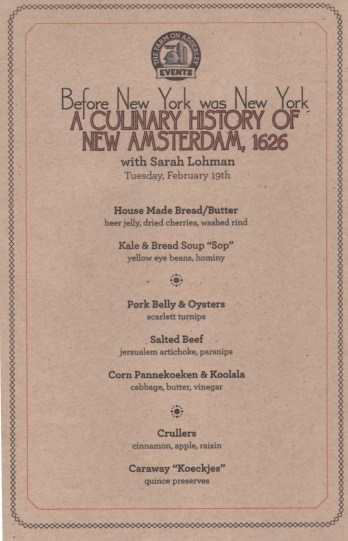
The Seasonal Menu: included: house-made bread & butter with dried fruit and cheese, kale & bread “sop”, salted beef, corn “panne­koeken”, a “koolsla” of cabbage, butter & vinegar, and for dessert – apple crullers and salted caraway “koeckjes” with quince preserves.

The Farm on Adderley’s well-curated drinks list features several cider and mead options which were the recommended pairings for the evening.

Ciders on offer included: Breezy Hill Farmhouse Cider, Farnum Hill Extra Dry Cider, and Sylboro Old Sin.

Cider #1: A glass of Breezy Hill Farmhouse Cider – A fresh, unfiltered, alive and lively apéritif. The perfect breakfast cider, also well matched to the bloomy rind cheese, dried fruits, beer jelly, and creamy, homemade butter.

Cider #2: A bottle of Slyboro Old Sin – Enjoyed throughout the meal. Well paired with the cured and roasted meats and exceptional when paired with the various root vegetables and bitter winter greens.

An emerging idea, noted in several of our upcoming American cider reviews: American craft ciders express an extremely strong affinity with raw, cooked, and pickled, root and cruciferous vegetables, especially – but not exclusively – greens. Brussel sprouts, cabbages, kales – this is where American cider parings seem to really express terroir. The humble, practical and sustaining greens are elevated by the cider and the straightforward pleasures of a well made cider are intensified when consumed with roots and greens. American agrarian character as part of a distinct American terroir or taste of place, is clearly expressed through the apple, the vegetable, and the cider maker’s craft.

These American ciders paired with humble roots and hardy greens lead to a deeply satisfying sense of well-being. The transporting quality of these pairings remind us of the pleasures of enjoying the “fruits of one’s own labors” at the table, as discussed in David Buchanan’s book Taste, Memory.

Cider #3: A glass of Farnum Hill Extra Dry Cider – with the koeckjes and crullers. A dry, crisp, compliment to the caraway, salt and spice of the sweets. Not an obvious choice as it deviates from the conventional sweet with sweet notion, but this mix of sweet, spice and ultra dry cider was, to our tastes, a very fine and refreshing ending to a most enjoyable meal.

Menu

This idea of a regional and historical meal in context is an interesting way to present ciders – and could easily inspire makers and purveyors to create their own locale and time specific cider dining or tasting event.

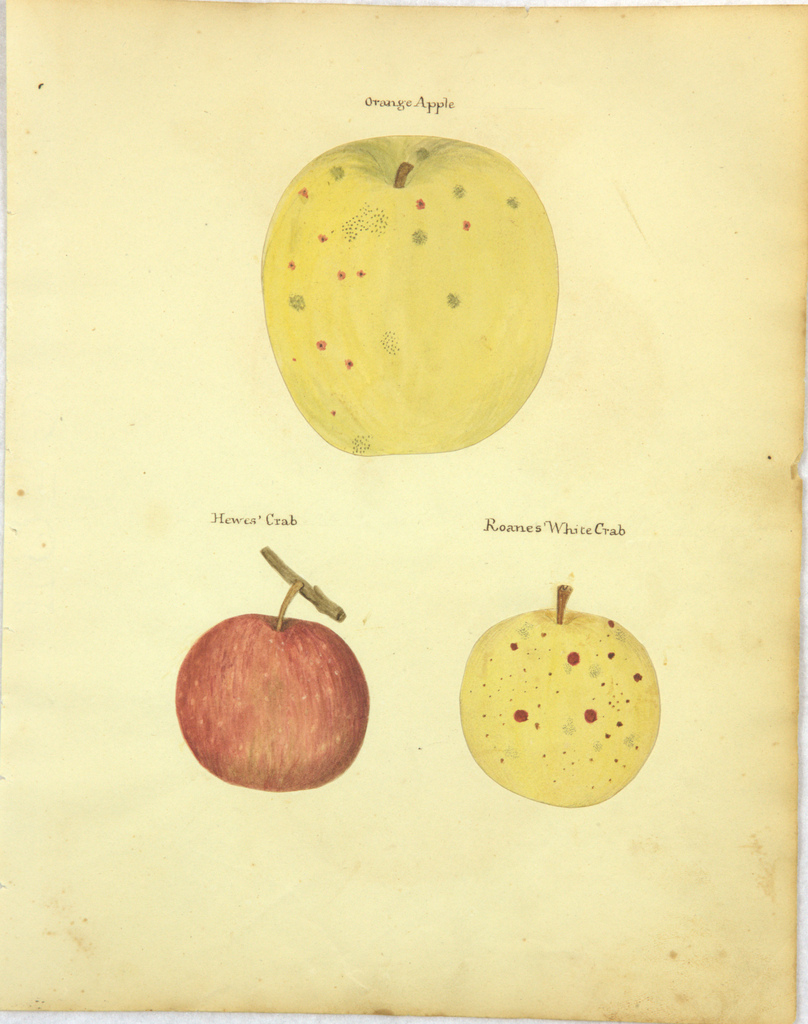
From The Atlas: Orange Apple, Hewe’s Crab & Roane’s White Crab

Orange Apple

Image Credit: Special Collections, National Agricultural Library.

Collection: William Coxe Manuscript. Contains Manuscript and Atlas. 

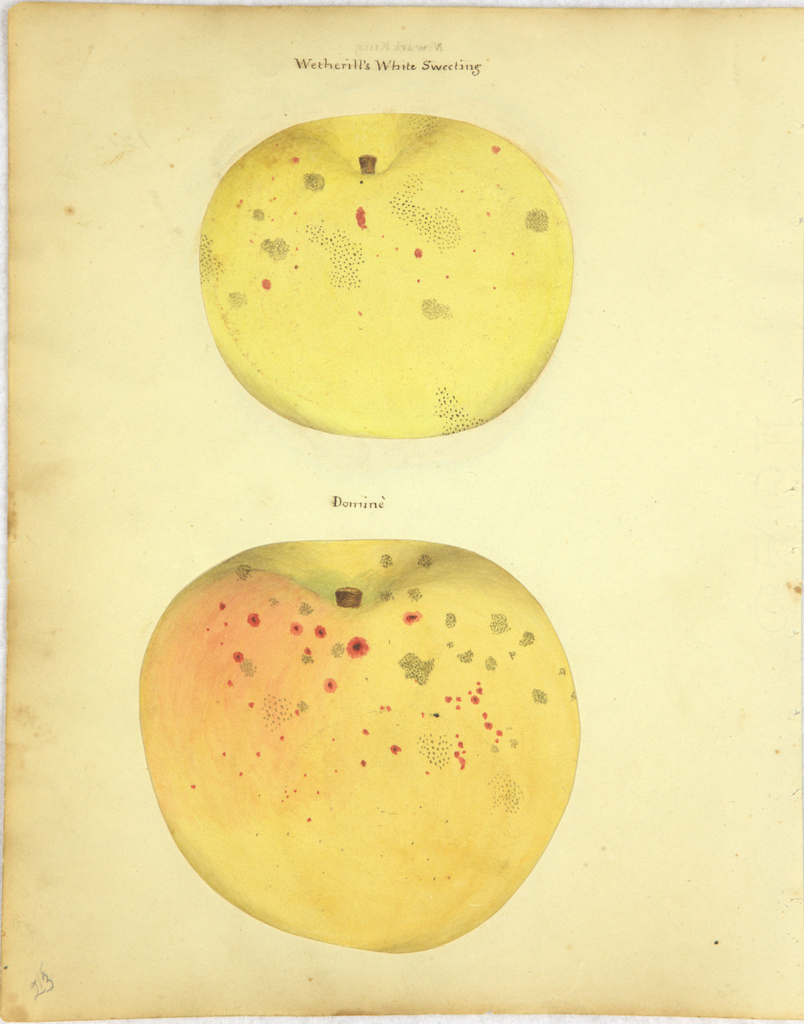
From The Atlas: Wetherill’s White Sweeting & Domini Apples

Wetherill's White Sweeting

Image Credit: Special Collections, National Agricultural Library.

Collection: William Coxe Manuscript. Contains Manuscript and Atlas. 

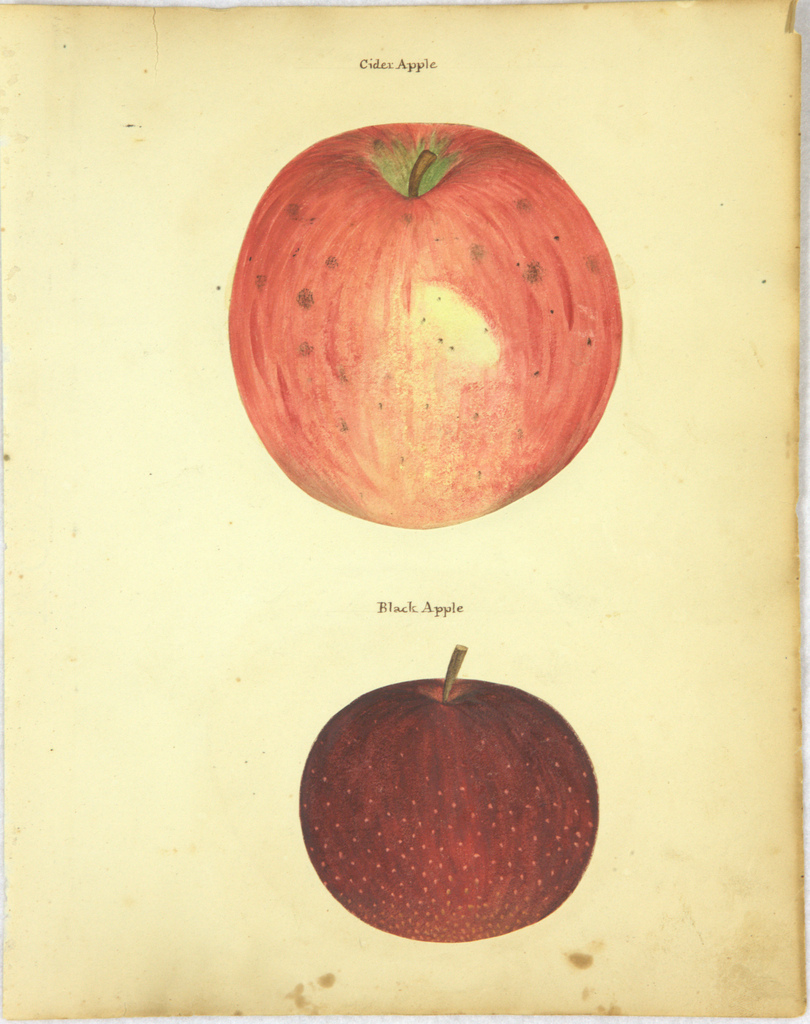
From The Atlas: Cider Apple & Black Apple


CiderApple&blackapple

Image Credit: Special Collections, National Agricultural Library.

Collection: William Coxe Manuscript. Contains Manuscript and Atlas. 

The Unpublished Atlas: A List of Apples. A View of the Cultivation of Fruit Trees by William Coxe.

Images of the 24 pomological watercolor illustrations, on 12 plates, listed below, are posted on at USDA National Agricultural Library website in the Rare Books Special Collections Image GalleryThe complete Atlas is digitized, but not all images from the Atlas are currently available in Rare Books Special Collections Image Gallery.
The originals are full size watercolor illustrations on Bristol board, created by Elizabeth Coxe McMurtry and her sisters to illustrate the unpublished second edition of their father’s book.
It is possible these images were painted circa 1817-1831, making them some of the earliest known color pomological illustrations of American fruits. An 1857 article in Country Gentleman magazine describes the watercolor illustrations in detail, indicating they were executed prior to that date.
Pomological illustrations currently on view online, as thumbnails, in the Rare Books Special Collections Image Gallery:
Note: The Atlas contains many more illustrations. The images posted are only a selection.
Apples:
Domini
Hewe’s Crab
Roane’s White Crab
Orange Apple
Grey House
Winesap
Harrison
Pomme d’Apis or Lady Apple
Poveshon
Siberian Crab
Styre
Loan’s English Pearmain
Rambo or Romanite
The Cider Apple
The Black Apple
White Sweet or Wheterills White Sweeting
Glouschester White
Fearn’s Pippin
Newton Pippin
Preistly
Esopus Spitzenburg
Vendervere
Fama Gusta
Peaches:
Red-Cheek Malacotan
Early Anne
Monstrous Pavie

Collection No. 44: William Coxe, Manuscript + Atlas of Apples

Collection Number: 44

Collection Name: Coxe, William, Manuscript
Earliest Date: 1810
Latest Date: 1831
Linear Feet: 0.5
Collection Description: The William Coxe Manuscript is a two-volume, undated manuscript on pomology. The first manuscript volume contains 832 pages of text and sketches of fruits which William Coxe used to write A View of the Cultivation of Fruit Trees in America, published in 1817. This volume includes notes with dates ranging from 1810-1828. The notes were intended for use in a second edition of A View of the Cultivation of Fruit Trees in America, which was never published due to Coxe’s death. The second manuscript volume consists of an atlas of life-size, watercolor plates of fruit on Bristol-board, painted by Coxe’s daughters. The watercolor plates are cut out from the Bristol-board and fastened to the leaves of the book, then each name is handwritten in pen above the illustration.

Historical or Biographical Sketch: William Coxe (1762-1831), a pomologist, was one of the foremost fruit growers in America who experimented with new varieties of fruits at his home in Burlington, New Jersey. He collected specimens from the United States and abroad. A View of the Cultivation of Fruit Trees in America is a classic of American pomological literature. It is considered by many specialists as the illustrative evidence of fruit culture during the colonial and revolutionary period of the new American nation. William A. Taylor, assistant pomologist, U.S. Department of Agriculture, read an 1857 article in Country Gentleman about the manuscript. Through the use of Library of Congress geneological materials, Taylor was able to contact Coxe’s family members and locate the manuscripts. The grandchildren of Elizabeth (Coxe) McMurtrie, one of Coxe’s daughters, donated the manuscripts to Secretary of Agriculture D. F. Houston in 1915.

ProcessedNo, contact Special Collections.
Formats: Agricultural Art and Memorabilia
Digitization Status: Portion of collection digitized

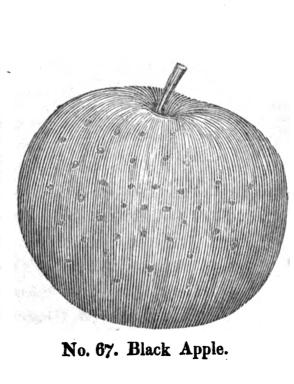
No.67

THE SEARCH FOR A VALUABLE UNPUBLISHED WORK OF AMERICAN POMOLOGY

From SCIENCE

NEW SERIES. VOLUME XLIV JULY-DECEMBER, 1916 NEW YORK

A VALUABLE UNPUBLISHED WORK ON POMOLOGY

Most horticulturists are doubtless familiar with “A View of the Cultivation of Fruit Trees of America,” published in 1817 by “William Coxe, of Burlington, N. J., who has been called “The Father of American Pomology,” but probably few are aware of the existence of an unpublished book of colored drawings of the fruits that were illustrated in this work by wood cuts. On pages 225-226 of the Country Gentleman, of Albany, ~N. Y., for April 2, 1857, there was published by E[dmund] L[aw] R[ogers], Baltimore, Md., an account of the activities of Mr. Coxe, in which it is stated that he had intended publishing a second edition of the work, accompanied by colored engravings for which natural-size water-color drawings had been prepared by his daughters. The publication of this second edition was prevented by Mr. Coxe’s death in 1831. About twenty years ago this article came to the attention of Mr. William A. Taylor, then assistant pomologist of the TJ. S. Department of Agriculture, and a number of letters were written in an effort to locate the colored drawings, but without success. The matter was then dropped until the spring of 1915 when, in a conversation regarding some old horticultural catalogs, Mr. Taylor related these facts to the writer who suggested that it might still be possible to locate the unpublished colored plates through methods used by genealogical research workers.

The search was begun by looking up at the Library of Congress historical and genealogical works which might give information regarding the descendants of William Coxe, with the result that a list of his children was obtained, with some of their marriages. From this it was learned that Philadelphia and vicinity was at present the most likely locality to search for his descendants. Addresses were obtained of several of the Coxe family in that vicinity and a form letter sent to all of them giving the object of the inquiry, with the result that a chart of this branch of the family, only recently published, was secured by the writer. This gave the names of all descendants to date, but without addresses, although the places of births were usually given. With this clue several city and tele- phone directories were consulted and addresses of most of the descendants obtained. About twenty-five copies of the form letter were then sent to these addresses with the almost immediate result of six replies giving the address of the probable possessor of the work, followed the next day by a letter from one of the twenty- five addressed acknowledging the possession of the work.

It is with great pleasure that announcement is made of the donation of the unpublished colored drawings of fruits to the Library of the U. S. Department of Agriculture by the grandchildren of Mrs. Elizabeth (Coxe) McMurtrie, a daughter of William Coxe, by whom most of the paintings were made. The drawings are bound and in an excellent state of preservation. The character of the work shows a high degree of skill on the part of the artist in depicting fruits; and the positive identification of all the earlier descriptions and illustrations, some of which have long been in doubt, will now be possible. The work has been placed in a fireproof building and it is expected that the additional safeguard of a fireproof safe for this and similar books will be provided at an early date. The drawings are accompanied by the bound manuscript upon which the published work was based, to which have been added numerous notes intended for a second edition.

Many of the notes bear dates ranging from 1810 to 1828 and it probable that the water-color work was largely done in the early part of this period, for several varieties are illustrated which according to the manuscript did not live long, or were destroyed as being of little value or particularly subject to disease.

P. L. RlCKER Bureau of Plant Industry

July 14, 1916

link: http://archive.org/stream/science441916mich/science441916mich_djvu.txt