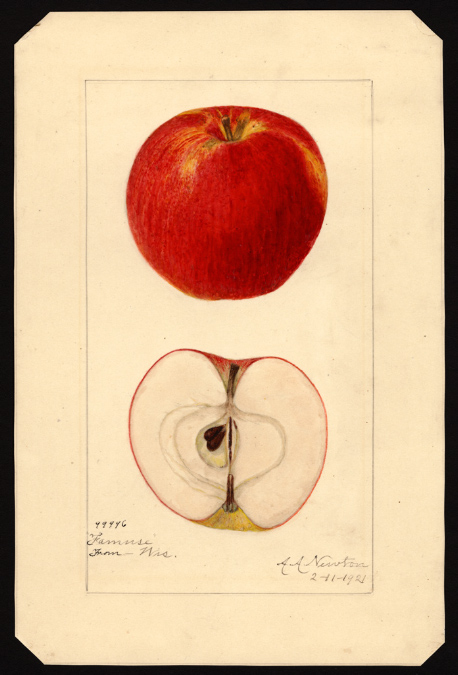
Pyrus communis: : Bon Chretien de Vernois Pear

POM00006904.BonChretienPear

Pyrus communis: : Bon Chretien de Vernois Pear

Artist:
Steadman, Royal Charles, b. 1875
Scientific name:
Pyrus communis
Common name:
pears
Variety:
Bon Chretien de Vernois
Geographic origin:
Saint Petersburg, Pinellas County, Florida, United States
Physical description:
1 art original : col. ; 17 x 25 cm.
Specimen:
95913
Year:
1918
Notes on original:
Martin Compas
Date created:
1918-09-27
Rights:
Use of the images in the U.S. Department of Agriculture Pomological Watercolor Collection is not restricted, but a statement of attribution is required. Please use the following attribution statement: “U.S. Department of Agriculture Pomological Watercolor Collection. Rare and Special Collections, National Agricultural Library, Beltsville, MD 20705”

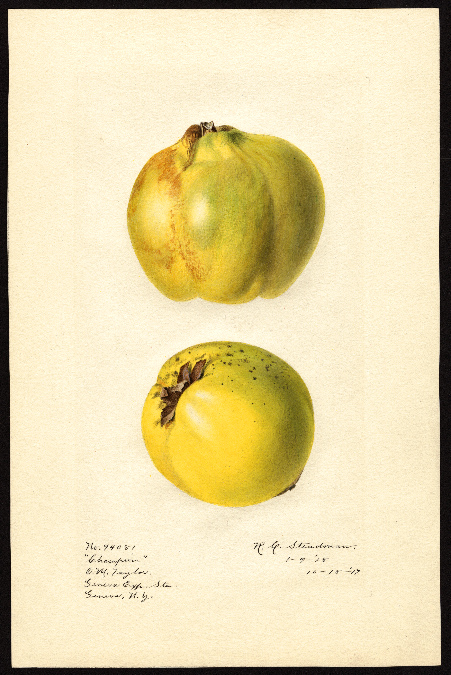
Cydonia oblonga: Champion Quince

POM00001122ChampionQuinceGEXS

Cydonia oblonga: Champion

Artist:
Steadman, Royal Charles, b. 1875
Scientific name:
Cydonia oblonga
Common name:
quinces
Variety:
Champion
Geographic origin:
Geneva, Ontario County, New York, United States
Physical description:
1 art original : col. ; 17 x 25 cm.
Specimen:
94081
Year:
1918
Notes on original:
Geneva Experiment Station
Date created:
1918-01-09
Rights:
Use of the images in the U.S. Department of Agriculture Pomological Watercolor Collection is not restricted, but a statement of attribution is required. Please use the following attribution statement: “U.S. Department of Agriculture Pomological Watercolor Collection. Rare and Special Collections, National Agricultural Library, Beltsville, MD 20705”

Cider52 Goal: A Cider Review A Week or 52 American Ciders in 2013

VA RT Treasures

Cider52: A Cider Review A Week The original plan: 52 weeks, 52 cider tastings, pairings and postings. As of May 3, 2013  we revised our goal, now it’s 52 American Made Ciders to be reviewed in 2013. We’ll continue to explore and review World Cider, but the 52 Ciders in 2013 goal is now CIDER USA.

With barely 13 weeks left in 2013 – we better get busy if we intended to meet our goal. So expect more cider reviews in these last few months of 2013 The Year of Cider.

US CIDERS REVIEWED SO FAR:

The list of American Ciders reviewed with links to the reviews:

January 2013

Original Sin Hard Cider Newtown Pippin

February 2013

Harvest Moon Cidery Four Screw Hard Cider with Maple Syrup

Pomona cider/braggot on cask, house brewed at Birreria, Eataly NY

March 2013

Slyboro Cider House Hidden Star

Slyboro Cider House Old Sin

April 2013

West Country Cider Redfield 

Harvest Moon Cidery Heritage Hops Hard Cider with Hops

Breezy Hill Orchard Hudson Valley Farmhouse Cider

West County Reine de Pomme 

Cider In Context: Breezy Hill Orchard Farmhouse Cider, Slyboro Cider Old Sin, Farnum Hill Extra Dry Cider

May 2013

Crispin THE SAINT

Crispin BARE NAKED 

Farnum Hill DOORYARD Batch 1202A 

Breezy HIll Orchard Barrel Tasting (6) ciders and barrel samples 

ANTHEM Organic Traditionally Fermented Cider 

June 2013

Aaron Burr Cider BOURBON BARREL CIDER Sparkling

Farnum Hill DOORYARD Batch 1206Tasting Journal

July 2013

Wandering  Aengus Ciderworks WANDERLUST 

August 2013

The Ciders of Summer. Our Favorite American Craft Ciders for Drinking Right Now:

September 2013

Farnum Hill FARMHOUSE CIDER

October 2013

Farnum Hill Cider DOORYARD STILL CIDER Batch 1214 pending

Eve’s Cider BECKHORN HOLLOW DRY CIDER pending

For a list of ALL ciders reviewed so far (Including ciders from around the world), see the CIDER REVIEWS: CIDER52 page.

What We’re Reading: Scott Laboratories 2013 -2014 Cider Handbook.

Scott 2013-14

What We’re Reading: The 2013 -2014 Cider Handbook from Scott Laboratories.

September 7, 2013 Scott Laboratories announced its first ever Cider Handbook.

Known for an annual fermentation handbook, with information and resources geared to the needs of wineries, breweries, and distilleries in North America, the people at Scott Labs felt it was time to create a handbook focused on cider:

“The 60-page Handbook contains products, articles, and protocols specific to the cider industry. With cider sales in the U.S. tripling since 2007, Scott recognized that this growing market needed attention.”

The 2013-2014 Cider Handbook, is available in the U.S. and Canada. To request a free copy email info@scottlab.com. Or visit www.scottlab.com.

The end papers of the handbook features images courtesy of Albemarle CiderWorks, depicting 32 apple varieties including Golden Pearmain, Razor Russet, Black Twig, Crow Egg, and Redfield.

Cider Mapping: NEW United States Cider Map with A-Z List by State at Cider Guide

Cider Mapping: See the NEW Map of United States Cider with A-Z List by State at Eric West’s Cider Guide.

A click on the map (below) will take you directly to Cider Guide.

Cider Guide US Map

(Our view of the map is current as of 10-4-2013. Go to www.ciderguide.com for the latest information).

When you want to know whose making cider, state by state in the US of A – check Eric West’s new map and list at ciderguide.com.

Cider Guide’s US CIDER map & list are helpfully color coded by category, and the list is organized by state. The information includes current  & announced cider producers, and producers of perry, ice cider, fruit wine, mead, and apple & pear spirits. Bottle shops that feature cider, and cider bars & restaurants are also noted.

Cider Guide’s current Stats for Cider in the US are:

 Cider Producers – 199
 Perry Producers – 19
 Ice Cider Producers – 17
 Fruit Wine (Apple/Pear) Producers – 46
 Mead (Apple/Pear) Producers – 26
 Spirits (Apple/Pear) Producers – 20
 Cider Bars/Pubs/Restaurants – 11
 Cider Bottle Shops – 14
 Cider Producers In-Planning – 27

Visit Cider Guide for a full view of the new US CIDER MAP and take a look at the cider maps for the rest of the world as well.

If you have notes or additions, please visit Cider Guide and leave a comment www.ciderguide.com.


Aaron Burr Bourbon Barrel Cider – If You Find It, Drink It.

LOC apple image

Aaron Burr Bourbon Barrel Cider is only available at a handful of select establishments in the North East, and in very limited quantities.

A few sources we might suggest:

Jimmy’s No. 43 NYC

The Queen’s Kickshaw Astoria, Queens, NY

Eleven Madison Park  NYC

If You Find It – Drink It. We sincerely believe you will not be disappointed. You won’t have the opportunity to drink this cider again for at least 14 months.

Andy Brennan ages his small batch micro-crafted cider in bourbon barrels for 2 years – and there won’t be another release until very late in 2014 .

Here is a link to our tasting notes for Aaron Burr Bourbon Barrel Cider Sparkling.

If you want to explore the world of Aaron Burr Cider click here

And do read and enjoy Aaron Burr Cider’s Cider 101: True Cider in America

Cider Week NY Event: Talking About History: The History of Cider-making in New York with Andy Brennan of Aaron Burr Cider, Oct 13, 3-4 PM. RSVP required: programs@kingmanor.org.

The King Manor Museum
150-03 Jamaica Ave. (150th and 153rd Streets
Queens, NY 11432
For more 2013 Cider Week NY Events check the website www.ciderweekny.com
And for a full list of Aaron Burr Cider stockists check the link locations-find us

(Early) American Cider Apples From DANIEL SMITH and CO. Nursery, Burlington, New Jersey 18o4

Agricultural.

Extract.

From The Trenton Federalist.
1803
One of the best opportunities for improving their plantations with choice fruit is now offered to the farmers in this part country, by the opening of the extensive nursery of Daniel Smith & Co. of Burlington, for the sale of trees. This nursery has been many years in  forming is certainly one of the grandest collections of choice trees in the United States. No expense nor pains have been spared to make the collection complete, and the taking bids fair to produce the greatest benefits to the agricultural interests of West Jersey. 1
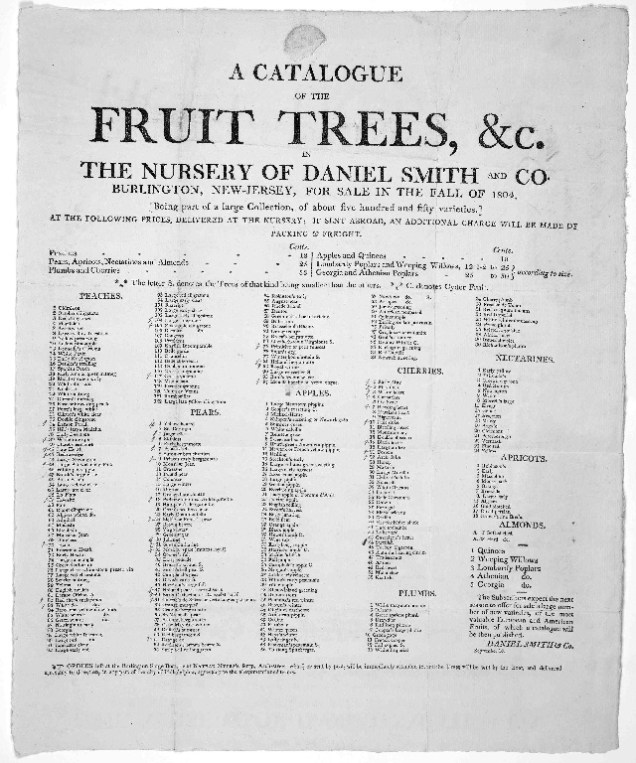
danielsmithfruittreecatalogue1804-s

Below is a list of (early) American Cider Apples from DANIEL SMITH & CO. of Burlington, New Jersey, circulated as a broadsheet catalog for apple trees available in the fall of 18o4.

AMERICAN CIDER APPLES.
Note:
“The letter S. denotes the Trees of that kind being smaller than the others. C. denotes Cyder Fruit.”
  • APPLES.
  • 1 Large Newtown pippins
  • 2 Cooper’s russeting C.
  • 3 Michael-Henry
  • 4 Shippen’s russeting or Newark gate
  • 5 Summer queen
  • 6 White calville
  • 7 Reinette grise
  • 8 Sweet and sour
  • 9 Hunt’s green Newtown pippin
  • 11 Newark or French yellow pippin
  • 12 Redling
  • 13 Stockton’s early
  • 15 Large red and green sweeting
  • 16 Large early harvest
  • 17 Monstrous pippin
  • 18 Large piplin
  • 19 Golden pippin
  • 20 Everlasting apple
  • 21 Lady apple or Pomme d’Apis
  • 22 Doctor apple
  • 23 English codling
  • 24 Swett’s harvest
  • 25 Early junating
  • 26 Belle fleur
  • 27 Orange apple
  • 28 Black apple
  • 29 Hewes’s crab C.
  • 30 Wine sop
  • 31 Early bough apple
  • 32 Harrison apple C.
  • 33 Maiden’s blush
  • 34 Fall pippin
  • 35 Campfield’s apple C.
  • 36 Morgan’s apple
  • 37 Little early reinette
  • 38 White’s early pearmain
  • 39 Wine apple
  • 43 Rhode-Island greening
  • 44 Roman stem
  • 45 Pennock’s red winter
  • 46 Brown’s winter
  • 47 Gilpin or carthouse
  • 48 American pippin
  • 49 Catline
  • 50 Rambour
  • 51 Winter queen
  • 52 Hays’s winter
  • 53 Lady finger S.
  • 55 Ruckman’s pearmain S.
  • 56 Flushing Spitzbergen
  • 57 Newtown do. S.
  • 58 Aesopus do.
  • 59 Jersey greening
  • 60 American nonpareil
  • 61 Quince apple
  • 62 Burlington late pearmain
  • 65 Priestly
  • 67 Greyhouse or romanite
  • 71 Grub’s summer
  • 76 Granny Winkle C.
  • 83 Burlington greening
  • 84 Red Calville
  • 85 Newark sweeting.
A catalogue of the fruit trees, &c. in the nursery of Daniel Smith and Co. Burlington, New Jersey, for sale in the fall of 1804 …. [Burlington, 1804].
Source: Library of Congress, Rare Book and Special Collections Division.

Heirloom Apples. New Amsterdam Market.

3 Apples Grav, Pitmaston, H.Nonesuch

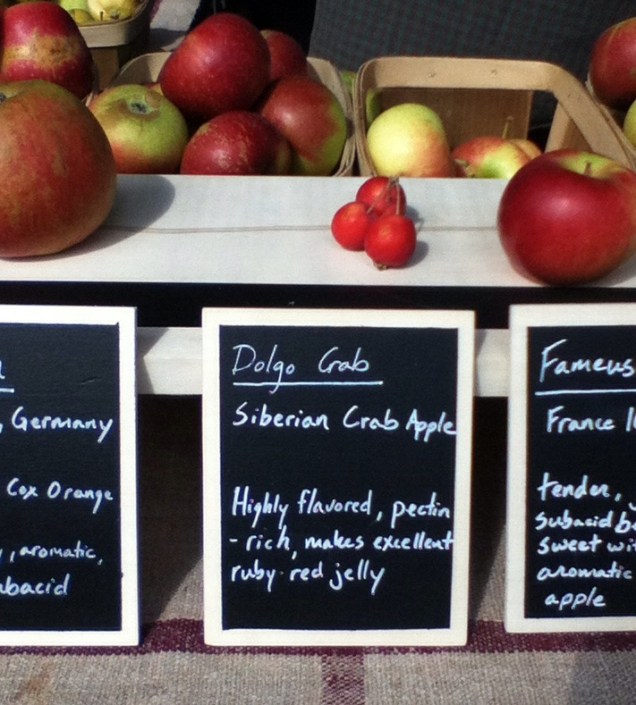
New Amsterdam Market at the old Fulton Fish Market, on South Street and Peck Slip in Lower Manhattan, this Sunday, September 29th, featured regional cheese makers and dairy products. We could not resist these beautiful apples at the Flying Fox stall. Gravenstein, Pitmaston Pineapple, Hubbardston Nonesuch, diminutive Dolgo Crab, the charmingly named Famuese, to mention only a few, each more lovely than the next.

Grav, Pitmaston & Hubardston NAM

Support your local growers and farmers markets, and encourage fruit diversity by ‘eating it to save it’. Enjoy the seasons beautiful heritage pome fruits.

Dolgo-close

New Amsterdam Market www.newamsterdammarket.org:

“Since 2006, New Amsterdam Market has advocated for the preservation and rehabilitation of the Old Fulton Fish Market, a public-owned site of immense value for both cultural and economic development.”

Read more about the vision for the Seaport and the Market District here.

Flying Fox, fruit hand-picked and selected by fruiterer, Maggie Nescuir.

Apple Belts of North America circa 1914.

LOC apple image

The Standard Cyclopedia of Horticulture:

Apple belts.

In comparing the great apple growing regions of the continent it is convenient to designate each by its leading variety. In the eastern part of the continent, there is the Fameuse or Wealthy belt on the north, the Ben Davis belt on the south, and the Baldwin belt lying intermediate between these two. It is seen that varieties differ greatly as to their adaptability to different regions. The degree of soil aeration and of soil moisture and the range of atmospheric and soil temperatures are among the most important determining factors of the geographical range of commercial apple growing with any variety. Passing westward into the mid continental region it is found that the Baldwin belt does not extend west of Lake Michigan. The climatic extremes are here too severe for that variety and many of its eastern associates of a similar degree of hardiness.

In all that vast territory which extends westward from the Great Lakes these varieties disappear and do not again appear till the states of the Pacific Coast are reached. Instead the Wealthy belt extends southward till it reaches the region where Wealthy yields leadership to Ben Davis. In this connection it is worthy of note that from the Atlantic Coast westward to the Missouri River, the north margin of the Ben Davis belt approximately coincides with the southern boundary of the geological area covered by the Wisconsin drift.

Wealthy belt.

The mid-continental territory in which Wealthy is generally speaking the leading variety includes northern Illinois, the north half of Iowa, and practically all of the apple growing districts of Wisconsin, Minnesota, South Dakota, and northern Nebraska. Among the more important varieties associated with it are for the more northern parts Oldenburg, Okabenal, Patten (Patten Greening) and Malinda. Among the very hardiest of the large size apples for the North are those of the Hibernal group, but their fruit is so austere that it is esteemed of little value except for culinary uses. In the southern part of the Wealthy belt are grown hardy varieties of more or less local value such as Salome, Windsor, Black Annette and Colorado Orange varieties which as yet have not established themselves in the great world markets but which are valued where better varieties cannot be satisfactorily grown.

Ben Davis belt.

Generally speaking, Ben Davis is the leading variety in central and southern Illinois, the south half of Iowa, and the apple growing districts of Arkansas, Oklahoma, Missouri, Kansas and the south half of Nebraska. With its close kin the Gano, and the Black Ben Davis which evidently are highly colored bud sports of Ben Davis. it probably produces at least one half of the commercial apple crop in this region. Winesap and Jonathan appear to be next in order of importance with Winesap perhaps in the lead. Other important varieties are Grimes, Rome Beauty, Willow (Twig), Missouri (Pippin), Minkler and Ralls. York Imperial is gaining ground Stayman Winesap is one of the newer kinds which will be more largely planted. Delicious also is attracting attention particularly because of its agreeable dessert quality and good appearance. The Stayman and Delicious are being planted to some extent in the southern part of the Wealthy belt as Jonathan and Grimes have been.

Page 325.

From:

The Standard Cyclopedia of Horticulture:

A Discussion for the Amateur, and the Professional and Commercial Grower, of the Kinds, Characteristics and Methods of Cultivation of the Species of Plants Grown in the Regions of the United States and Canada for Ornament, for Fancy, for Fruit and for Vegetables; with Keys to the Natural Families and Genera, Descriptions of the Horticultural Capabilities of the States and Provinces and Dependent Islands, and Sketches of Eminent Horticulturists, Volume 1

Edited by Liberty Hyde Bailey, Macmillan, 1914

Read or download a copy via google here.
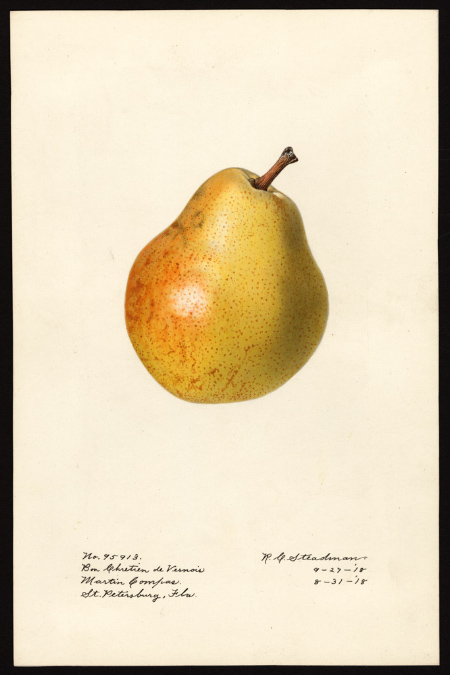
Malus domestica: Fameuse

POM00002208

Malus domestica: Fameuse

Artist:
Newton, Amanda Almira, ca. 1860-1943
Scientific name:
Malus domestica
Common name:
apples
Variety:
Fameuse
Geographic origin:
Wisconsin, United States
Physical description:
1 art original : col. ; 17 x 25 cm.
Specimen:
99996
Year:
1921
Notes on original:
Exhibited at A.P.S. Meeting, Columbus, OH, Dec. 1-4, 1920
Date created:
1921
Rights:
Use of the images in the U.S. Department of Agriculture Pomological Watercolor Collection is not restricted, but a statement of attribution is required. Please use the following attribution statement: “U.S. Department of Agriculture Pomological Watercolor Collection. Rare and Special Collections, National Agricultural Library, Beltsville, MD 20705”