From The Atlas: Greyhouse and Winesap

WC2

Image Credit: Special Collections, National Agricultural Library.

Collection: William Coxe Manuscript. Contains Manuscript and Atlas. 
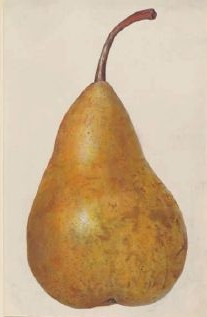
Other Pome Fruits: Pears and Quince Considered

bosc6_med

Other Pome Fruits: Pears and Quince Considered.

American cider makers are exploring cider beyond the apple. Pears, and even Quince, can be crafted into quite fine ciders. Along with our ongoing apple based cider research, upcoming posts will consider these other pome fruits, and the unique ciders, perrys and poires their artful fermentation produces.
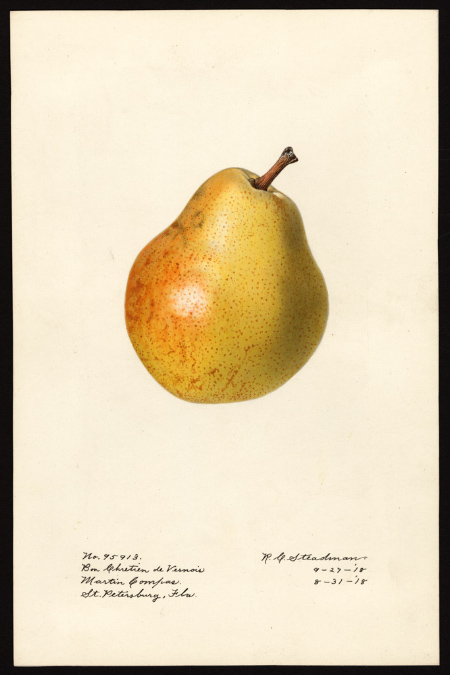
Pyrus communis: : Bon Chretien de Vernois Pear

POM00006904.BonChretienPear

Pyrus communis: : Bon Chretien de Vernois Pear

Artist:
Steadman, Royal Charles, b. 1875
Scientific name:
Pyrus communis
Common name:
pears
Variety:
Bon Chretien de Vernois
Geographic origin:
Saint Petersburg, Pinellas County, Florida, United States
Physical description:
1 art original : col. ; 17 x 25 cm.
Specimen:
95913
Year:
1918
Notes on original:
Martin Compas
Date created:
1918-09-27
Rights:
Use of the images in the U.S. Department of Agriculture Pomological Watercolor Collection is not restricted, but a statement of attribution is required. Please use the following attribution statement: “U.S. Department of Agriculture Pomological Watercolor Collection. Rare and Special Collections, National Agricultural Library, Beltsville, MD 20705”

(Early) American Cider Apples From DANIEL SMITH and CO. Nursery, Burlington, New Jersey 18o4

Agricultural.

Extract.

From The Trenton Federalist.
1803
One of the best opportunities for improving their plantations with choice fruit is now offered to the farmers in this part country, by the opening of the extensive nursery of Daniel Smith & Co. of Burlington, for the sale of trees. This nursery has been many years in  forming is certainly one of the grandest collections of choice trees in the United States. No expense nor pains have been spared to make the collection complete, and the taking bids fair to produce the greatest benefits to the agricultural interests of West Jersey. 1
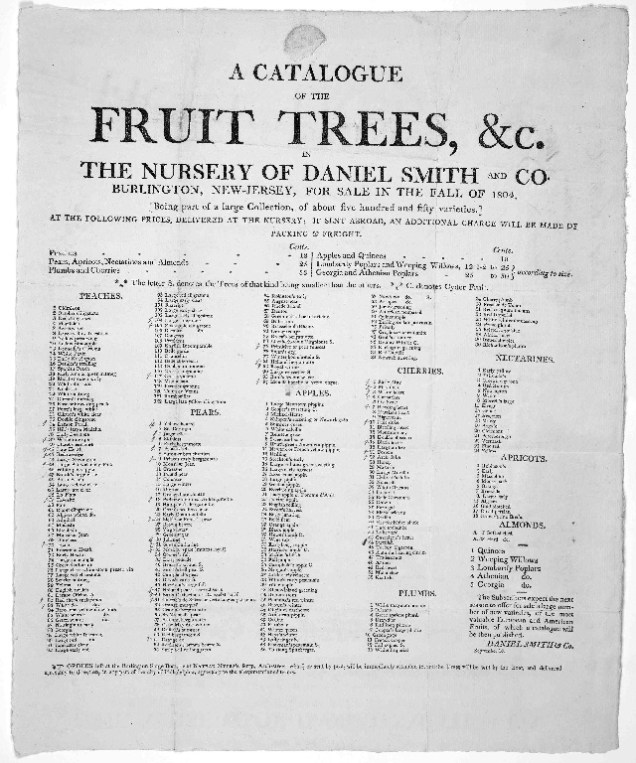
danielsmithfruittreecatalogue1804-s

Below is a list of (early) American Cider Apples from DANIEL SMITH & CO. of Burlington, New Jersey, circulated as a broadsheet catalog for apple trees available in the fall of 18o4.

AMERICAN CIDER APPLES.
Note:
“The letter S. denotes the Trees of that kind being smaller than the others. C. denotes Cyder Fruit.”
  • APPLES.
  • 1 Large Newtown pippins
  • 2 Cooper’s russeting C.
  • 3 Michael-Henry
  • 4 Shippen’s russeting or Newark gate
  • 5 Summer queen
  • 6 White calville
  • 7 Reinette grise
  • 8 Sweet and sour
  • 9 Hunt’s green Newtown pippin
  • 11 Newark or French yellow pippin
  • 12 Redling
  • 13 Stockton’s early
  • 15 Large red and green sweeting
  • 16 Large early harvest
  • 17 Monstrous pippin
  • 18 Large piplin
  • 19 Golden pippin
  • 20 Everlasting apple
  • 21 Lady apple or Pomme d’Apis
  • 22 Doctor apple
  • 23 English codling
  • 24 Swett’s harvest
  • 25 Early junating
  • 26 Belle fleur
  • 27 Orange apple
  • 28 Black apple
  • 29 Hewes’s crab C.
  • 30 Wine sop
  • 31 Early bough apple
  • 32 Harrison apple C.
  • 33 Maiden’s blush
  • 34 Fall pippin
  • 35 Campfield’s apple C.
  • 36 Morgan’s apple
  • 37 Little early reinette
  • 38 White’s early pearmain
  • 39 Wine apple
  • 43 Rhode-Island greening
  • 44 Roman stem
  • 45 Pennock’s red winter
  • 46 Brown’s winter
  • 47 Gilpin or carthouse
  • 48 American pippin
  • 49 Catline
  • 50 Rambour
  • 51 Winter queen
  • 52 Hays’s winter
  • 53 Lady finger S.
  • 55 Ruckman’s pearmain S.
  • 56 Flushing Spitzbergen
  • 57 Newtown do. S.
  • 58 Aesopus do.
  • 59 Jersey greening
  • 60 American nonpareil
  • 61 Quince apple
  • 62 Burlington late pearmain
  • 65 Priestly
  • 67 Greyhouse or romanite
  • 71 Grub’s summer
  • 76 Granny Winkle C.
  • 83 Burlington greening
  • 84 Red Calville
  • 85 Newark sweeting.
A catalogue of the fruit trees, &c. in the nursery of Daniel Smith and Co. Burlington, New Jersey, for sale in the fall of 1804 …. [Burlington, 1804].
Source: Library of Congress, Rare Book and Special Collections Division.

Heirloom Apples. New Amsterdam Market.

3 Apples Grav, Pitmaston, H.Nonesuch

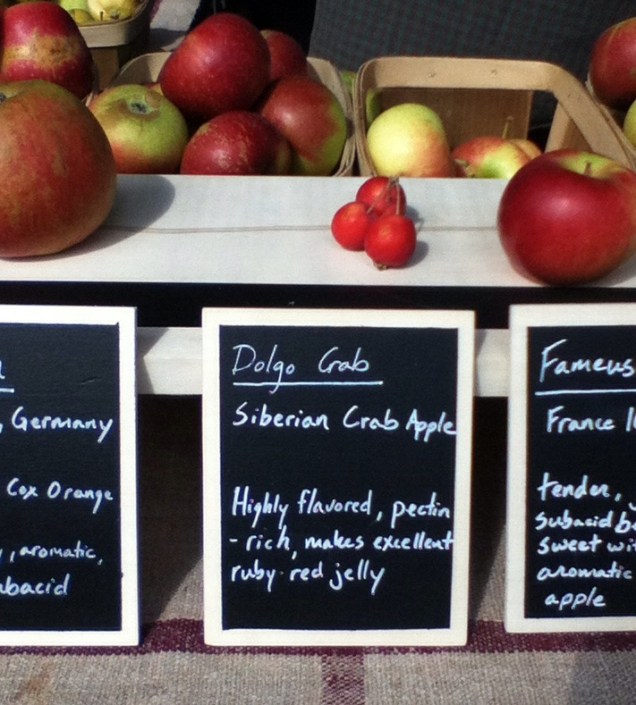
New Amsterdam Market at the old Fulton Fish Market, on South Street and Peck Slip in Lower Manhattan, this Sunday, September 29th, featured regional cheese makers and dairy products. We could not resist these beautiful apples at the Flying Fox stall. Gravenstein, Pitmaston Pineapple, Hubbardston Nonesuch, diminutive Dolgo Crab, the charmingly named Famuese, to mention only a few, each more lovely than the next.

Grav, Pitmaston & Hubardston NAM

Support your local growers and farmers markets, and encourage fruit diversity by ‘eating it to save it’. Enjoy the seasons beautiful heritage pome fruits.
Dolgo-close

New Amsterdam Market www.newamsterdammarket.org:

“Since 2006, New Amsterdam Market has advocated for the preservation and rehabilitation of the Old Fulton Fish Market, a public-owned site of immense value for both cultural and economic development.”

Read more about the vision for the Seaport and the Market District here.

Flying Fox, fruit hand-picked and selected by fruiterer, Maggie Nescuir.

Apple Belts of North America circa 1914.

LOC apple image

The Standard Cyclopedia of Horticulture:

Apple belts.

In comparing the great apple growing regions of the continent it is convenient to designate each by its leading variety. In the eastern part of the continent, there is the Fameuse or Wealthy belt on the north, the Ben Davis belt on the south, and the Baldwin belt lying intermediate between these two. It is seen that varieties differ greatly as to their adaptability to different regions. The degree of soil aeration and of soil moisture and the range of atmospheric and soil temperatures are among the most important determining factors of the geographical range of commercial apple growing with any variety. Passing westward into the mid continental region it is found that the Baldwin belt does not extend west of Lake Michigan. The climatic extremes are here too severe for that variety and many of its eastern associates of a similar degree of hardiness.

In all that vast territory which extends westward from the Great Lakes these varieties disappear and do not again appear till the states of the Pacific Coast are reached. Instead the Wealthy belt extends southward till it reaches the region where Wealthy yields leadership to Ben Davis. In this connection it is worthy of note that from the Atlantic Coast westward to the Missouri River, the north margin of the Ben Davis belt approximately coincides with the southern boundary of the geological area covered by the Wisconsin drift.

Wealthy belt.

The mid-continental territory in which Wealthy is generally speaking the leading variety includes northern Illinois, the north half of Iowa, and practically all of the apple growing districts of Wisconsin, Minnesota, South Dakota, and northern Nebraska. Among the more important varieties associated with it are for the more northern parts Oldenburg, Okabenal, Patten (Patten Greening) and Malinda. Among the very hardiest of the large size apples for the North are those of the Hibernal group, but their fruit is so austere that it is esteemed of little value except for culinary uses. In the southern part of the Wealthy belt are grown hardy varieties of more or less local value such as Salome, Windsor, Black Annette and Colorado Orange varieties which as yet have not established themselves in the great world markets but which are valued where better varieties cannot be satisfactorily grown.

Ben Davis belt.

Generally speaking, Ben Davis is the leading variety in central and southern Illinois, the south half of Iowa, and the apple growing districts of Arkansas, Oklahoma, Missouri, Kansas and the south half of Nebraska. With its close kin the Gano, and the Black Ben Davis which evidently are highly colored bud sports of Ben Davis. it probably produces at least one half of the commercial apple crop in this region. Winesap and Jonathan appear to be next in order of importance with Winesap perhaps in the lead. Other important varieties are Grimes, Rome Beauty, Willow (Twig), Missouri (Pippin), Minkler and Ralls. York Imperial is gaining ground Stayman Winesap is one of the newer kinds which will be more largely planted. Delicious also is attracting attention particularly because of its agreeable dessert quality and good appearance. The Stayman and Delicious are being planted to some extent in the southern part of the Wealthy belt as Jonathan and Grimes have been.

Page 325.

From:

The Standard Cyclopedia of Horticulture:

A Discussion for the Amateur, and the Professional and Commercial Grower, of the Kinds, Characteristics and Methods of Cultivation of the Species of Plants Grown in the Regions of the United States and Canada for Ornament, for Fancy, for Fruit and for Vegetables; with Keys to the Natural Families and Genera, Descriptions of the Horticultural Capabilities of the States and Provinces and Dependent Islands, and Sketches of Eminent Horticulturists, Volume 1

Edited by Liberty Hyde Bailey, Macmillan, 1914

Read or download a copy via google here.
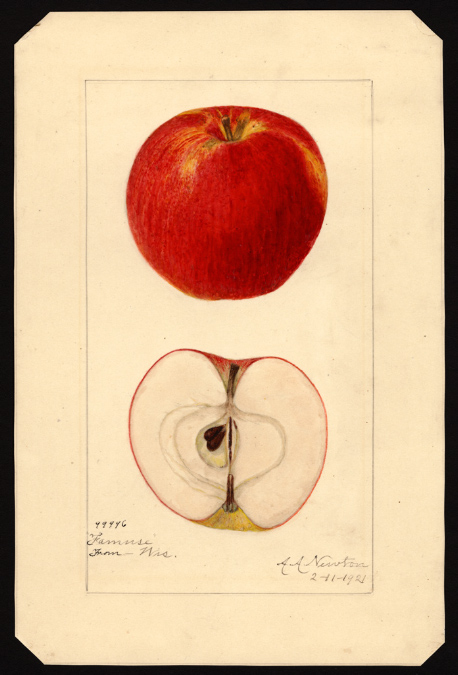
Malus domestica: Fameuse

POM00002208

Malus domestica: Fameuse

Artist:
Newton, Amanda Almira, ca. 1860-1943
Scientific name:
Malus domestica
Common name:
apples
Variety:
Fameuse
Geographic origin:
Wisconsin, United States
Physical description:
1 art original : col. ; 17 x 25 cm.
Specimen:
99996
Year:
1921
Notes on original:
Exhibited at A.P.S. Meeting, Columbus, OH, Dec. 1-4, 1920
Date created:
1921
Rights:
Use of the images in the U.S. Department of Agriculture Pomological Watercolor Collection is not restricted, but a statement of attribution is required. Please use the following attribution statement: “U.S. Department of Agriculture Pomological Watercolor Collection. Rare and Special Collections, National Agricultural Library, Beltsville, MD 20705”

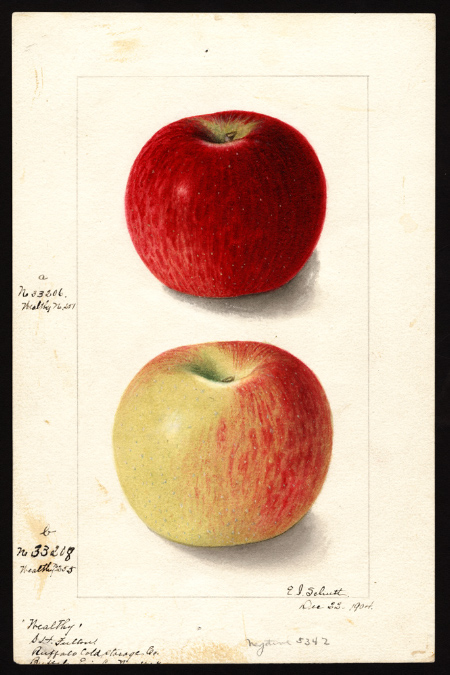
Malus domestica: Wealthy

POM00003669

Malus domestica: Wealthy

Artist:
Schutt, Ellen Isham, 1873-1955
Scientific name:
Malus domestica
Common name:
apples
Variety:
Wealthy
Geographic origin:
Buffalo, Erie County, New York, United States
Physical description:
1 art original : col. ; 17 x 25 cm.
NAL note:
Alternative variety name(s): Wealthy 251a, Wealthy 255b
Specimen:
33206; 33208
Year:
1904
Notes on original:
Negative Number 5342; 33206a – [Irog?] first picking. 33206b – 2 cultivation first picking
Date created:
1904
Rights:
Use of the images in the U.S. Department of Agriculture Pomological Watercolor Collection is not restricted, but a statement of attribution is required. Please use the following attribution statement: “U.S. Department of Agriculture Pomological Watercolor Collection. Rare and Special Collections, National Agricultural Library, Beltsville, MD 20705”

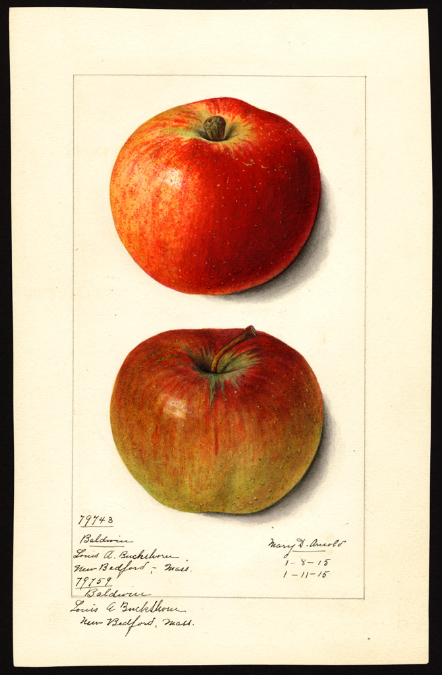
Malus domestica: Baldwin

POM00001449

Malus domestica: Baldwin

Artist:
Arnold, Mary Daisy, ca. 1873-1955
Scientific name:
Malus domestica
Common name:
apples
Variety:
Baldwin
Geographic origin:
New Bedford, Bristol County, Massachusetts, United States
Physical description:
1 art original : col. ; 16 x 25 cm.
Specimen:
79743; 79759
Year:
1915
Date created:
1915-01-11
Rights:
Use of the images in the U.S. Department of Agriculture Pomological Watercolor Collection is not restricted, but a statement of attribution is required. Please use the following attribution statement: “U.S. Department of Agriculture Pomological Watercolor Collection. Rare and Special Collections, National Agricultural Library, Beltsville, MD 20705”

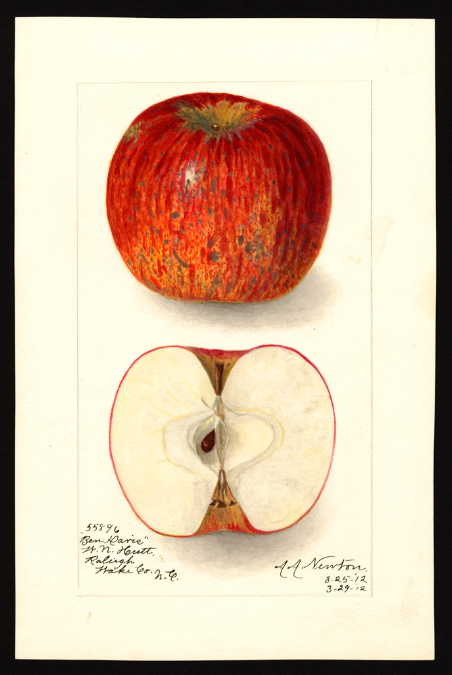
Malus domestica: Ben Davis

POM00000163

Malus domestica: Ben Davis

Artist:
Newton, Amanda Almira, ca. 1860-1943
Scientific name:
Malus domestica
Common name:
apples
Variety:
Ben Davis
Geographic origin:
Raleigh, Wake County, North Carolina, United States
Physical description:
1 art original : col. ; 17 x 25 cm.
Specimen:
55896
Year:
1912
Date created:
1912-03-29
Rights:
Use of the images in the U.S. Department of Agriculture Pomological Watercolor Collection is not restricted, but a statement of attribution is required. Please use the following attribution statement: “U.S. Department of Agriculture Pomological Watercolor Collection. Rare and Special Collections, National Agricultural Library, Beltsville, MD 20705”