1911 Encyclopedia Britannica: Entry: Cider

cropped-3b51100rappleprint3.jpeg

CIDER, or Cyder (from the Fr. cidre, derived from the Lat. sicera or cisera, Gr. veicepa, Heb. shekar, strong drink), an alcoholic beverage made from apples.

Cider and perry (the corresponding beverage made from pears) are liquors containing from as little as 2% of alcohol to 7 or 8%, seldom more, and rarely as much, produced by the vinous fermentation of the expressed juice of apples and pears; but cider and perry of prime quality can only be obtained from vintage fruit, that is, apples and pears grown for the purpose and unsuited for the most part for table use. A few table apples make good cider, but the best perry is only to be procured from pears too harsh and astringent for consumption in any other form. The making of perry is in England confined, in the main, to the counties of Hereford, Worcester and Gloucester. These three counties, together with Somerset and Devon, constitute, too, the principal cider-making district of the country; but the industry, which was once more widely spread, still survives in Norfolk, and has lately been revived in Kent, though, in both these counties, much of the fruit used in cider-making is imported from the west country and some from the continent. Speaking generally, the cider of Herefordshire is distinguished for its lightness and briskness, that of Somerset for its strength, and that of Devonshire for its lusciousness.

Cider used to be made in the south of Ireland, but the industry had almost become extinct until revived by the Department of Agriculture, which in 1904 erected a cider-making plant at Drogheda, Co. Louth, gave assistance to private firms at Dungarvan, Co. Waterford, and Fermoy, Co. Cork, and provided a travelling mill and press to work in the South Riding of Co. Tipperary. The results have been highly satisfactory, a large quantity of good cider having been produced.

Inasmuch as English orchards are crowded with innumerable varieties of cider apples, many of them worthless, a committee composed of members of the Herefordshire Fruit-Growers’ Association and of the Fruit and Chrysanthemum Society was appointed in 1899 to make a selection of vintage apples and pears best suited to Herefordshire and the districts adjoining. The following is the list drawn up by the committee: Apples. – Old Foxwhelp, Cherry Pearmain, Cowarne Red, Dymock Red, Eggleton Styre, Kingston Black or Black Taunton, Skyrme’s Kernel, Spreading Redstreak, Carrion apple, Cherry Norman, Cummy Norman, Royal Wilding, Handsome Norman, Strawberry Norman, White Bache or Norman, Broad-leaved Norman, Argile Grise, Bramtot, De Boutville, Frequin Audievre, Medaille d’Or, the last five being French sorts introduced from Normandy about 1880, and now established in the orchards of Herefordshire.

Source: Online version of the 1911 Encyclopedia Brittannica

Entry: Cider

Link: http://www.1911encyclopedia.org/Cider

“This free online 1911 Classic Encyclopedia is based on what many consider to be the best encyclopedia ever written: the eleventh edition of the Encyclopedia Britannica, first published in 1911.”
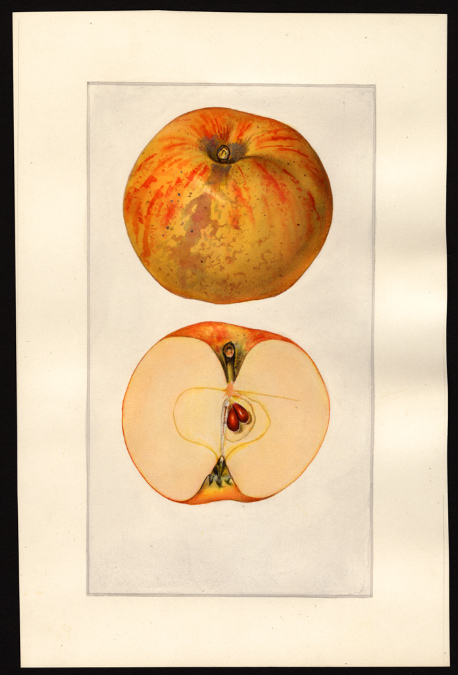
Malus domestica: Gravenstein. Rosslyn, Arlington County, Virginia, United States.

POM00002050Rosslyn, VAjpg

Malus domestica: Gravenstein

Artist:
Arnold, Mary Daisy, ca. 1873-1955
Scientific name:
Malus domestica
Common name:
apples
Variety:
Gravenstein
Geographic origin:
Rosslyn, Arlington County, Virginia, United States
Physical description:
1 art original : col. ; 17 x 25 cm.
Specimen:
106589
Year:
1925
Notes on original:
Access Number 8581; Section J, Row 23, Tree 5
Date created:
1925-08-17
Rights:
Use of the images in the U.S. Department of Agriculture Pomological Watercolor Collection is not restricted, but a statement of attribution is required. Please use the following attribution statement: “U.S. Department of Agriculture Pomological Watercolor Collection. Rare and Special Collections, National Agricultural Library, Beltsville, MD 20705”

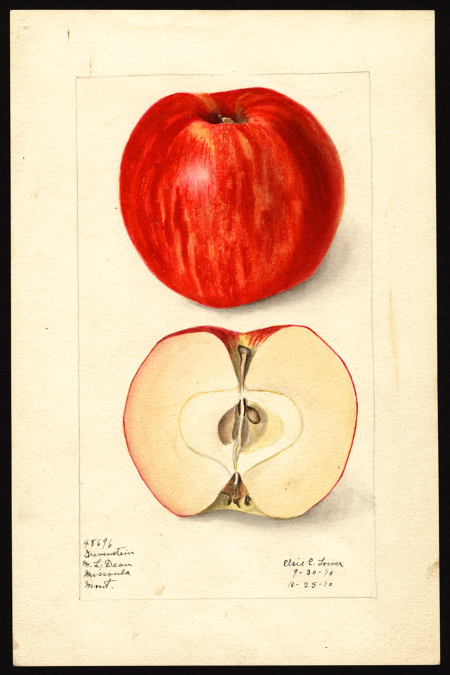
Malus domestica: Gravenstein. Missoula County, Montana, United States.

POM00002054Gravenstien, Missoula,MT

Malus domestica: Gravenstein

Artist:
Lower, Elsie E., b. 1882
Scientific name:
Malus domestica
Common name:
apples
Variety:
Gravenstein
Geographic origin:
Missoula, Missoula County, Montana, United States
Physical description:
1 art original : col. ; 17 x 25 cm.
Specimen:
48696
Year:
1910
Date created:
1910-10-25
Rights:
Use of the images in the U.S. Department of Agriculture Pomological Watercolor Collection is not restricted, but a statement of attribution is required. Please use the following attribution statement: “U.S. Department of Agriculture Pomological Watercolor Collection. Rare and Special Collections, National Agricultural Library, Beltsville, MD 20705”

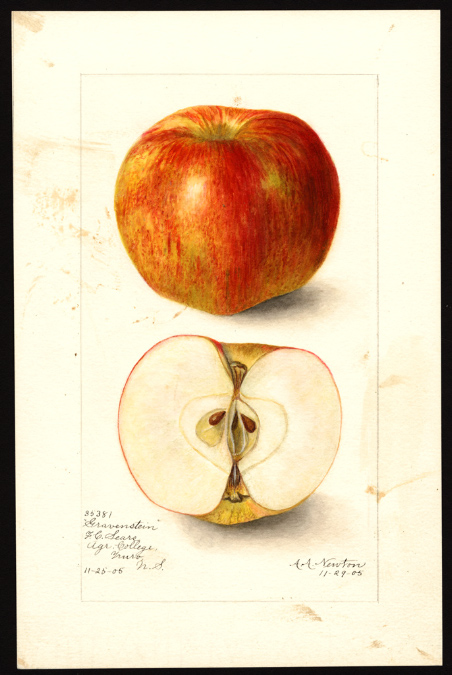
Malus domestica: Gravenstein. Truro, Nova Scotia, Canada.

POM00002053GravensteinNoveScotia

Malus domestica: Gravenstein

Artist:
Newton, Amanda Almira, ca. 1860-1943
Scientific name:
Malus domestica
Common name:
apples
Variety:
Gravenstein
Geographic origin:
Truro, Nova Scotia, Canada
Physical description:
1 art original : col. ; 17 x 25 cm.
Specimen:
35381
Year:
1905
Date created:
1905-11-29
Rights:
Use of the images in the U.S. Department of Agriculture Pomological Watercolor Collection is not restricted, but a statement of attribution is required. Please use the following attribution statement: “U.S. Department of Agriculture Pomological Watercolor Collection. Rare and Special Collections, National Agricultural Library, Beltsville, MD 20705”

5Ws of Cider: Jolie Devoto Wade & Apple Sauced Cider 2012 “Save the Gravenstein” Original

5Ws of Cider: Jolie Devoto Wade & Apple Sauced Cider 2012 “Save the Gravenstein” Original 

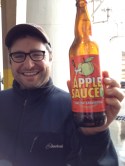
Hunter Wade of Apple Sauced Cider in Sebastopol, California answers our 5Ws of Cider pairing questions:
APPLE SAUCED LOGO
  • WHO: Jolie Devoto Wade, the farmer’s daughter and cidermaker.
  • WHAT: 2012 “Save the Gravenstein” Original. Crisp, tangy, acidic. Goes down exceptionally smooth. The secret: we grow all of our apples that we use, and we grow for flavor, not for quantity. The dry-farmed certified organic Gravensteins that “sweat” for a few days possess a wonderful aroma that comes through in the taste of the cider. Also, we’re tasting Sonoma County’s heritage apple in a glass. Jolie loves pairing the cider with our weekly catch of fish tacos, always made with a zesty slaw, fresh halibut or salmon, and a mean avocado salsa. Also great with meats and sharp cheeses.
  • WHERE: Anywhere with food.
  • WHEN: Since this cider is super food friendly, think lunch or dinner. But also, pop a bottle on the top of a hike, even if it’s in the morning. There have been too many times when we really could’ve used a nice refreshing drink of cider, and we had no bottle in hand. Next time.
  •  WHY: Jolie likes this pairing because it is a satisfying protein-rich meal, that wouldn’t be the same without the cider. She always says, “the cider fills in the cracks,” rather than “the cider opens up the stomach.” Our zesty tacos pair well with the clean crispness and smooth finish of the cider. Honestly the most food-friendly cider we’ve ever drunk.
To find out more:
IMG_0195AppleSauced

5Ws of Cider: The Cider: Apple Sauced Cider 2012 “Save the Gravenstein” Original and Devoto Orchards

5Ws of Cider: Jolie Devoto Wade & Apple Sauced Cider

2012 “Save the Gravenstein” Original 

APPLE SAUCED LOGO

Apple Sauced Cider 2012 “Save the Gravenstein” Original

CIDER MAKERS NOTES: 100% Gravenstein, Single Varietal Cider. Made from 100% Gravenstein apples, an heirloom apple variety that our county was once famous for but is now disappearing as the orchards are being pulled out and replaced with wine grapes. So we are calling it “SAVE THE GRAVENSTEIN” as part of our mission is to increase awareness for the variety. 22oz bottles, 6% ALC/VOL, 672 cases produced.

To find out more:

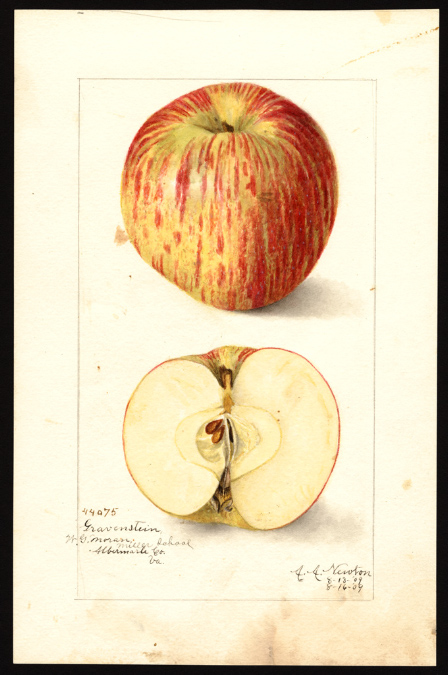
Malus domestica: Gravenstein. Albermarle County, Virginia, United States.

POM00002052

Malus domestica: Gravenstein

Artist:
Newton, Amanda Almira, ca. 1860-1943
Scientific name:
Malus domestica
Common name:
apples
Variety:
Gravenstein
Geographic origin:
Albermarle County, Virginia, United States
Physical description:
1 art original : col. ; 17 x 25 cm.
Specimen:
44075
Year:
1909
Date created:
1909-08-16
Rights:
Use of the images in the U.S. Department of Agriculture Pomological Watercolor Collection is not restricted, but a statement of attribution is required. Please use the following attribution statement: “U.S. Department of Agriculture Pomological Watercolor Collection. Rare and Special Collections, National Agricultural Library, Beltsville, MD 20705”

The 5Ws. Cider Pairing: Cider Makers Recommend Their Favorite Cider & Accompaniment.

LOC apple image

The 5Ws of Cider Pairing.

The 5Ws is a new feature launching today, where we ask cider makers to share their favorite cider & pairing.

We’ll give you the brand, the cider, the maker behind the cider, and their pairing suggestion.

Essentially the Who, What, When, Where, and Why of cider pairing from some of Americas most interesting craft cider makers.

We think makers who take the time to craft a well made cider, probably have some pretty interesting pairing suggestions.

First up: Jolie DeVoto Wade and Apple Sauced Cider.

On The Shelf: What We’re Reading: Fruitful Legacy: A Historic Context of Orchards in the United States

Fruitful Legacy: A Historic Context of Orchards in the United States, with Technical Information for Registering Orchards in the National Register of Historic Places

Author: Susan A. Dolan

url

Order: from The US Government Bookstore here

GPO Stock Number: 024-005-01266-4     ISBN:9780160821271
USA Price: $39.00   International Price: $54.60
Publisher: Interior Dept., National Park Service, Olmsted Center for Landscape Preservation, Pacific West Regional Office, Cultural Resources;
Park Historic Structures and Cultural Landscapes Program
Author: Dolan, Susan A.
Year/Pages: 2009: 251 p.; col. ill.   Binding: Paperback  Cover: Paper

Read and download: Online here at archive.org

See: National Parks Service: Cultural Landscapes

Nomeclature and Regional Expression: Pomme de Fer & Red Winter Pearmain

POM00002970PommedeFerCaliforniaImages of (4) different apple specimens from the NAL Library USDA Pomological Watercolor Collection

4 specimens

Collected from 3 locales in 3 States:

California, Vermont, Maine

From 3 different North American growing regions

Nomenclature: Pomme de Fer and Red Winter Pearmain

“An interesting little apple, to which I may draw your attention later in the report on new fruits, is this 
Pomme de Fer, literally the Iron apple, which originated in the Province of Quebec. It is a small dark apple and keeps easily until June.” 1
 
“Nevertheless Quebec has enriched American pomology by the gift of an apple which has added abundantly to the wealth and comfort of the people of North Eastern America.  To know this apple is to appreciate its great beauty and its surpassing fine quality.  But one should have it grown in the islands of Lake Champlain or in Western Quebec to secure it in all its glowing beauty and in all its crisp lusciousness.  You have no doubt guessed ere this that there is only one apple meriting this description La Belle Fameuse.  Quebec Tradition – because precise history fails – tells us that the Fameuse came to us with the advent of the Norman colonists.  It is the characteristic apple of the upper St Lawrence valley and I might add of the Lake Champlain region.  Fruit growing in the Province began as no doubt it did in New England with the growing of seedling fruits in the gardens of those who had brought with them from the old land a love of horticulture. The early gardens of Quebec and Montreal were famous for their collections of apples and even of pears. From these early plantings many varieties of some local fame have originated.  In addition to the Fameuse and its large seedling progeny might be mentioned St Lawrence, Pomme de fer, and Canada Baldwin.” 2