Deborah Madison Vegetable Literacy
Roots Diane Morgan
Deborah Madison Vegetable Literacy
Roots Diane Morgan
New Amsterdam Dinner at The Farm on Adderley: Cider In Context
Before New York Was New York: A Culinary History of New Amsterdam, 1626
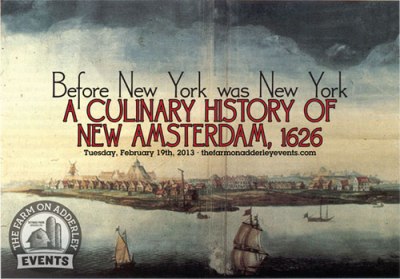
Venue: The Farm on Adderley restaurant and event space.
What: Dinner – A curated and contextualized meal inspired by early Dutch settlers in Nieuwe Amsterdam and the Lefferts’ family cookbook. The Leffert’s were early Dutch settlers with a stronghold of land in the Flatbush (“Vlacke Bos”) area of Brooklyn.
Context Provided By: Historic Gastronomist, Sarah Lohman, founder and author of Four Pounds Flour Historic Gastronomy blog.
The Seasonal Menu: included: house-made bread & butter with dried fruit and cheese, kale & bread “sop”, salted beef, corn “pannekoeken”, a “koolsla” of cabbage, butter & vinegar, and for dessert – apple crullers and salted caraway “koeckjes” with quince preserves.
The Farm on Adderley’s well-curated drinks list features several cider and mead options which were the recommended pairings for the evening.
Ciders on offer included: Breezy Hill Farmhouse Cider, Farnum Hill Extra Dry Cider, and Sylboro Old Sin.
Cider #1: A glass of Breezy Hill Farmhouse Cider – A fresh, unfiltered, alive and lively apéritif. The perfect breakfast cider, also well matched to the bloomy rind cheese, dried fruits, beer jelly, and creamy, homemade butter.
Cider #2: A bottle of Slyboro Old Sin – Enjoyed throughout the meal. Well paired with the cured and roasted meats and exceptional when paired with the various root vegetables and bitter winter greens.
An emerging idea, noted in several of our upcoming American cider reviews: American craft ciders express an extremely strong affinity with raw, cooked, and pickled, root and cruciferous vegetables, especially – but not exclusively – greens. Brussel sprouts, cabbages, kales – this is where American cider parings seem to really express terroir. The humble, practical and sustaining greens are elevated by the cider and the straightforward pleasures of a well made cider are intensified when consumed with roots and greens. American agrarian character as part of a distinct American terroir or taste of place, is clearly expressed through the apple, the vegetable, and the cider maker’s craft.
These American ciders paired with humble roots and hardy greens lead to a deeply satisfying sense of well-being. The transporting quality of these pairings remind us of the pleasures of enjoying the “fruits of one’s own labors” at the table, as discussed in David Buchanan’s book Taste, Memory.
Cider #3: A glass of Farnum Hill Extra Dry Cider – with the koeckjes and crullers. A dry, crisp, compliment to the caraway, salt and spice of the sweets. Not an obvious choice as it deviates from the conventional sweet with sweet notion, but this mix of sweet, spice and ultra dry cider was, to our tastes, a very fine and refreshing ending to a most enjoyable meal.
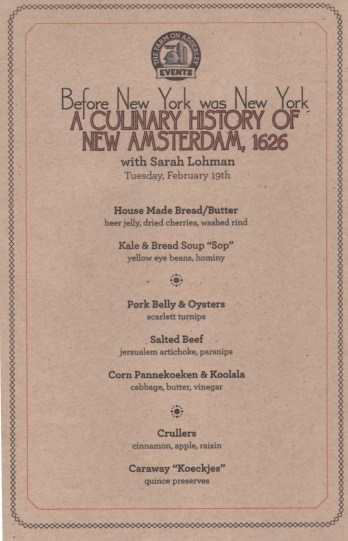
This idea of a regional and historical meal in context is an interesting way to present ciders – and could easily inspire makers and purveyors to create their own locale and time specific cider dining or tasting event.
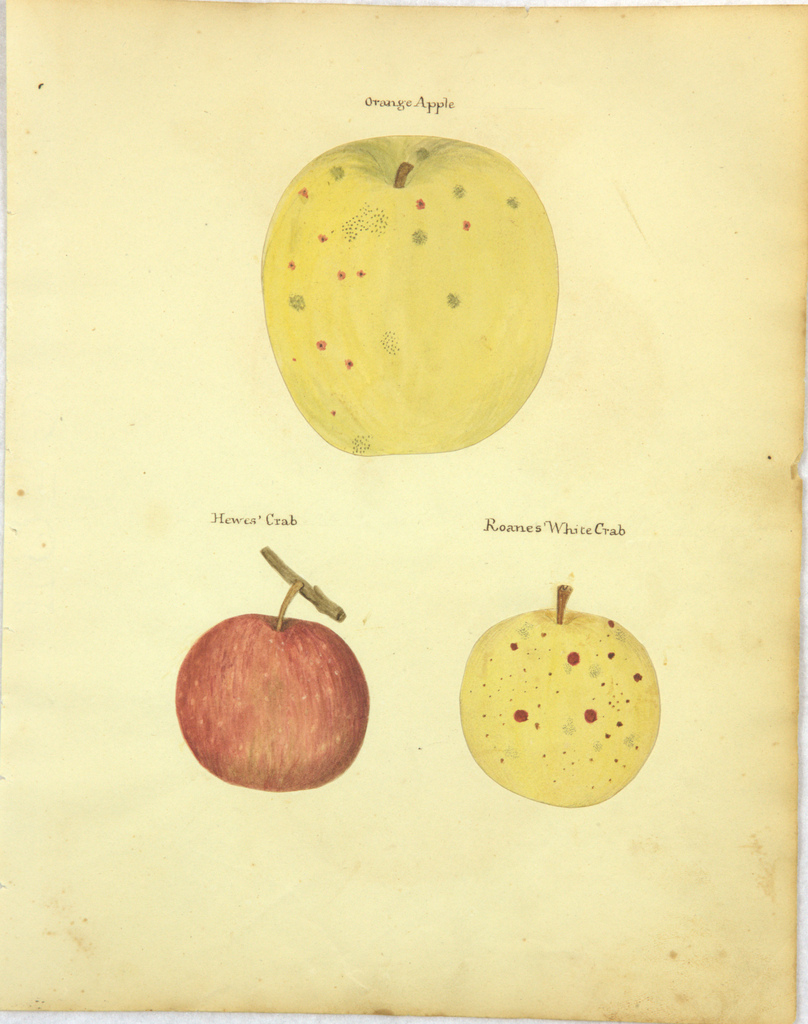
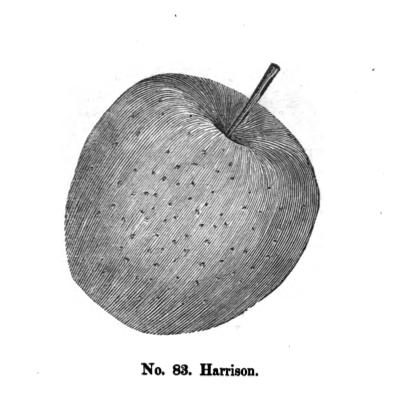
Image Credit: Special Collections, National Agricultural Library.
Collection: William Coxe Manuscript. Contains Manuscript and Atlas.
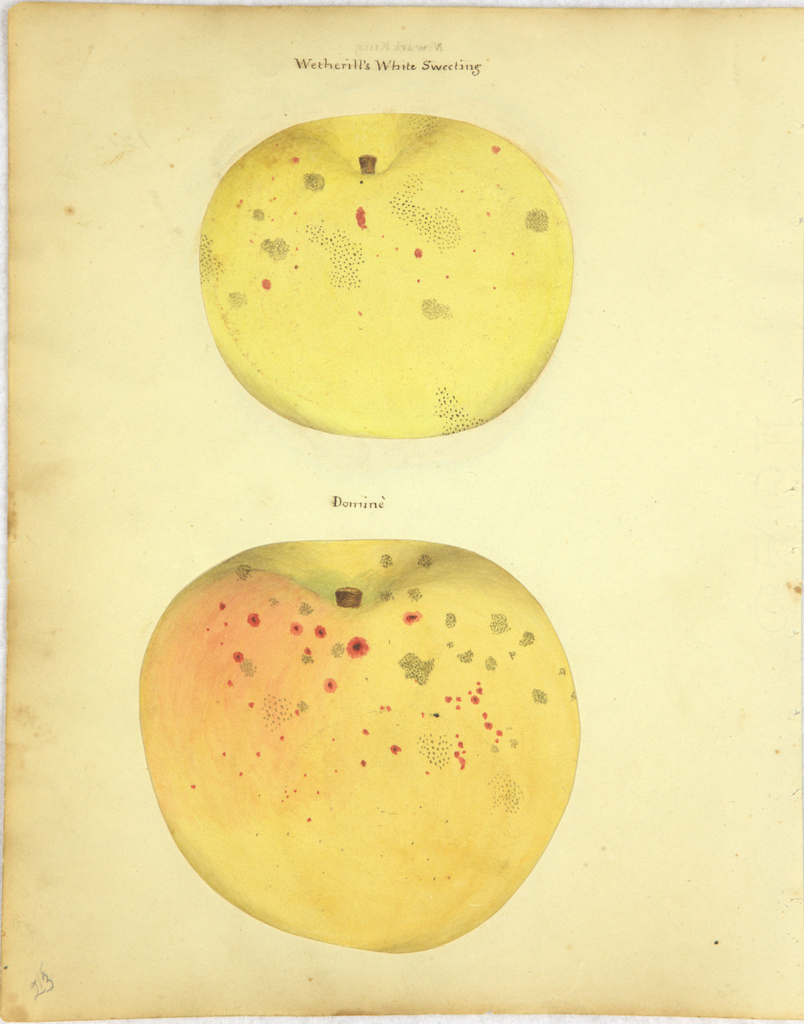
Image Credit: Special Collections, National Agricultural Library.
Collection: William Coxe Manuscript. Contains Manuscript and Atlas.
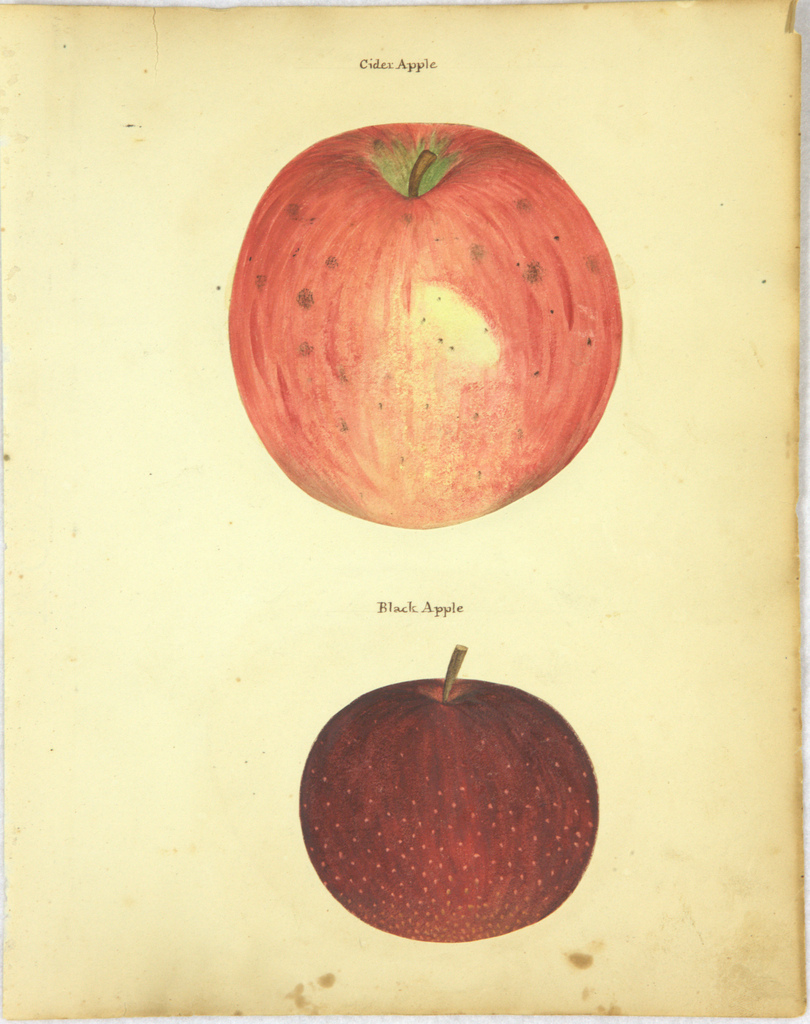
Image Credit: Special Collections, National Agricultural Library.
Collection: William Coxe Manuscript. Contains Manuscript and Atlas.
Collection Number: 44
Collection Name: Coxe, William, Manuscript
Earliest Date: 1810
Latest Date: 1831
Linear Feet: 0.5
Collection Description: The William Coxe Manuscript is a two-volume, undated manuscript on pomology. The first manuscript volume contains 832 pages of text and sketches of fruits which William Coxe used to write A View of the Cultivation of Fruit Trees in America, published in 1817. This volume includes notes with dates ranging from 1810-1828. The notes were intended for use in a second edition of A View of the Cultivation of Fruit Trees in America, which was never published due to Coxe’s death. The second manuscript volume consists of an atlas of life-size, watercolor plates of fruit on Bristol-board, painted by Coxe’s daughters. The watercolor plates are cut out from the Bristol-board and fastened to the leaves of the book, then each name is handwritten in pen above the illustration.
Historical or Biographical Sketch: William Coxe (1762-1831), a pomologist, was one of the foremost fruit growers in America who experimented with new varieties of fruits at his home in Burlington, New Jersey. He collected specimens from the United States and abroad. A View of the Cultivation of Fruit Trees in America is a classic of American pomological literature. It is considered by many specialists as the illustrative evidence of fruit culture during the colonial and revolutionary period of the new American nation. William A. Taylor, assistant pomologist, U.S. Department of Agriculture, read an 1857 article in Country Gentleman about the manuscript. Through the use of Library of Congress geneological materials, Taylor was able to contact Coxe’s family members and locate the manuscripts. The grandchildren of Elizabeth (Coxe) McMurtrie, one of Coxe’s daughters, donated the manuscripts to Secretary of Agriculture D. F. Houston in 1915.
Processed: No, contact Special Collections.
Formats: Agricultural Art and Memorabilia
Digitization Status: Portion of collection digitized
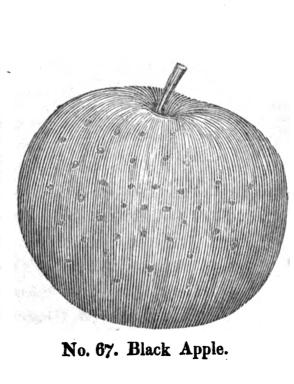
From SCIENCE
NEW SERIES. VOLUME XLIV JULY-DECEMBER, 1916 NEW YORK
A VALUABLE UNPUBLISHED WORK ON POMOLOGY
Most horticulturists are doubtless familiar with “A View of the Cultivation of Fruit Trees of America,” published in 1817 by “William Coxe, of Burlington, N. J., who has been called “The Father of American Pomology,” but probably few are aware of the existence of an unpublished book of colored drawings of the fruits that were illustrated in this work by wood cuts. On pages 225-226 of the Country Gentleman, of Albany, ~N. Y., for April 2, 1857, there was published by E[dmund] L[aw] R[ogers], Baltimore, Md., an account of the activities of Mr. Coxe, in which it is stated that he had intended publishing a second edition of the work, accompanied by colored engravings for which natural-size water-color drawings had been prepared by his daughters. The publication of this second edition was prevented by Mr. Coxe’s death in 1831. About twenty years ago this article came to the attention of Mr. William A. Taylor, then assistant pomologist of the TJ. S. Department of Agriculture, and a number of letters were written in an effort to locate the colored drawings, but without success. The matter was then dropped until the spring of 1915 when, in a conversation regarding some old horticultural catalogs, Mr. Taylor related these facts to the writer who suggested that it might still be possible to locate the unpublished colored plates through methods used by genealogical research workers.
The search was begun by looking up at the Library of Congress historical and genealogical works which might give information regarding the descendants of William Coxe, with the result that a list of his children was obtained, with some of their marriages. From this it was learned that Philadelphia and vicinity was at present the most likely locality to search for his descendants. Addresses were obtained of several of the Coxe family in that vicinity and a form letter sent to all of them giving the object of the inquiry, with the result that a chart of this branch of the family, only recently published, was secured by the writer. This gave the names of all descendants to date, but without addresses, although the places of births were usually given. With this clue several city and tele- phone directories were consulted and addresses of most of the descendants obtained. About twenty-five copies of the form letter were then sent to these addresses with the almost immediate result of six replies giving the address of the probable possessor of the work, followed the next day by a letter from one of the twenty- five addressed acknowledging the possession of the work.
It is with great pleasure that announcement is made of the donation of the unpublished colored drawings of fruits to the Library of the U. S. Department of Agriculture by the grandchildren of Mrs. Elizabeth (Coxe) McMurtrie, a daughter of William Coxe, by whom most of the paintings were made. The drawings are bound and in an excellent state of preservation. The character of the work shows a high degree of skill on the part of the artist in depicting fruits; and the positive identification of all the earlier descriptions and illustrations, some of which have long been in doubt, will now be possible. The work has been placed in a fireproof building and it is expected that the additional safeguard of a fireproof safe for this and similar books will be provided at an early date. The drawings are accompanied by the bound manuscript upon which the published work was based, to which have been added numerous notes intended for a second edition.
Many of the notes bear dates ranging from 1810 to 1828 and it probable that the water-color work was largely done in the early part of this period, for several varieties are illustrated which according to the manuscript did not live long, or were destroyed as being of little value or particularly subject to disease.
P. L. RlCKER Bureau of Plant Industry
July 14, 1916
link: http://archive.org/stream/science441916mich/science441916mich_djvu.txt
Historical or Biographical Sketch:
“William Coxe (1762-1831), a pomologist, was one of the foremost fruit growers in America who experimented with new varieties of fruits at his home in Burlington, New Jersey. He collected specimens from the United States and abroad. A View of the Cultivation of Fruit Trees in America is a classic of American pomological literature. It is considered by many specialists as the illustrative evidence of fruit culture during the colonial and revolutionary period of the new American nation.”
source: Special Collections, National Agricultural Library
The full title of his masterwork:
A View of the Cultivation of Fruit Trees, and the Management of Orchards and Cider: with accurate descriptions of the most estimable varieties of native and foreign apples, pears, peaches, plums, and cherries, cultivated in the middle states of America : illustrated by cuts of two hundred kinds of fruits of the natural size : intended to explain some of the errors which exist relative to the origin, popular names, and character of many of our fruits, to identify them by accurate descriptions of their properties and correct delineations of the full size and natural formation of each variety, and to exhibit a system of practice adapted to our climate, in the successive stages of a nursery, orchard, and cider establishment.
His book can be found and read online via google books and archive.org.
He was also a Statesmen. Entry for William Coxe Jr. Biographical Directory of the United States Congress, 1774-2005:
“He was a Representative from New Jersey; born in Burlington, N.J., May 3, 1762; served as a member of the State general assembly 1796-1804, 1806-1809, and again in 1816 and 1817; served as speaker 1798-1800 and again in 1802; elected as a Federalist to the Thirteenth Congress (March 4, 1813-March 3, 1815); author; died in Burlington, Burlington County, N.J., on February 25, 1831; interment in St. Mary’s Churchyard.”
“He also had a national reputation for his cider, at an age when it was a famous and characteristic beverage” this according to Proceedings of the State Horticultural Society at Its Annual Session, Volume 42 , New Jersey State Horticultural Society, 1917.
Cider – An alcoholic beverage traditionally made from fermented apple juice, currently experiencing a craft revival.
We say cider. We mean a fermented (alcoholic) apple or other pome fruit beverage. We are following the world tradition (and until the early 20th century, the American tradition) of calling a fermented apple beverage cider, and referring to apple and other pome fruit juice, as juice or sweet cider. Part of OUR American Craft Cider Revival effort is helping to revive the use of the word cider as the description for fermented apple juice.
It’s cider, anything else is just juice.
Note: We are aware that the current legal definition in the United States is, in summary: hard cider: a still apple wine of 7% or less alcohol by volume. But things are changing.
For a detailed description of the current legal definitions in the United States see:
Hard Cider, Semi-Generic Wine Designations, and Wholesale Liquor Dealers’ Signs (97-2523) 2001
 UnitedStatesofCider